
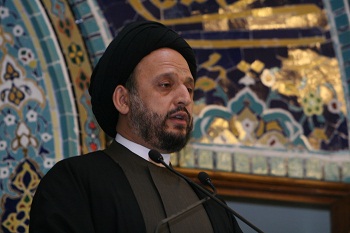
His Eminence, Sayyed Ali Fadlullah, delivered the two Friday prayer sermons at the Imamain Al-Hassanain Mosque, Shawwal 12th 1435 H. – July, 08th 2014. Several prominent religious scholars, dignitaries and thousands of believers attended the Jumu’a prayer.
Following is a summary:
The First Sermon
In the first sermon, His Eminence, Sayyed Ali Fadlullah, talked about the middle nation that Allah wanted the Muslims to be an example of. He explained that such a nation is a moderate nation in its materialistic and moral values; a nation that is moderate in its faith: it neither exaggerates nor neglects. It is moderate in its morals and relations. It does not live in isolation, nor does it forget its identity.
Being in the middle, according to the Quran, differs from its meaning in the political context, which is usually to be neutral between good and evil. It is a positive attitude that stands with the right and justice. It is a right between two falsehoods and moderation between two extremes. Take for example the concept of generosity; it lies in the middle position between stinginess and squandering.
Intermediation is the criterion to distinguish what is religious and what is not. Islam, for instance, did not make the interest of society superior to that of the individual nor did it do the opposite. On another level, it called upon the believers to strike a balance between the needs of the soul and those of the body. It also warned against exaggeration in understanding religion. Even in Jihad it allowed man to fight, provided that he does exceed the limits. Thus, being in a middle position is an act of justice and balance.
The Sayyed then warned against extremism in the name of religion. He explained that the Takfiri thought will not only lead to killing and destruction, but it will also make the youth reject the entire religious thought. The best solution would be to return to the original Islam that no mind or heart can repel.
The Sayyed ended by explaining that the call to intermediation is not due to the prevailing circumstances. Nay, this is what Islam is and what we should call for at all times.
The second sermon
In the second sermon, His Eminence, Sayyed Ali Fadlullah, began by Gaza whose people emerged strong and more determined to hold on to their land and liberate it from the occupiers. He added that Gaza has taught the enemy a lesson similar to that it received in Lebanon, and it has proven that the land is no longer vulnerable to incursions or invasions and that any such move will cost dearly.
On the other hand, Gaza told all those who are responsible of the internal wars in the Arab and Muslim worlds that the real war is against Israel. It presented an example of the nation’s ability to achieve victory, even when it was left all alone. The Sayyed also said that he is confident that what Gaza did not give in war will not concede in negotiations. The Sayyed called on all those who stood with the Palestinians to continue to support their demands of lifting the blockade and rebuilding the country.
On another level, the war against Iraq is waged by those who do not want its people to unite and enjoy stability, and its politicians have not yet reached an agreement over the government… faced by these conditions, the Sayyed called on all components of the Iraqi people to confront the imminent dangers, and he praised the cooperation between the Kurds and the Iraqi government. He also called for the establishment of an effective and inclusive government to act as a guarantee for the stability of Iraq.
Concerning the demand of the Christian clergy in Lebanon for a stand by the Islamic authorities and figures towards what is happening in Mosul, the Sayyed explained that such Fatwas are not necessary, for those who are killing and throwing the Christians out of their country are not acting according to Islam, but rather against its teachings.
In Lebanon, the Sayyed hoped that Lebanon has eradicated the project that is similar to what is going on in Syria and Iraq thanks to the unity of the Lebanese and their support to the Army. He added that this is not time for scoring points; rather, it is a time for unity.
Furthermore, the Sayyed said that amid these circumstances, he appreciates any support for the Lebanese army, urging the political parties in Lebanon to provide internal stability that would further enable the army to face the Takfiris.
/149



