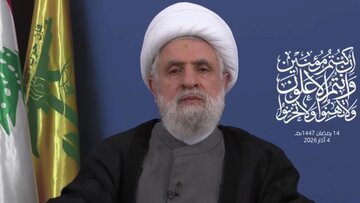
(Ahlul Bayt News Agency) - The First Sermon
In the first sermon, His Eminence, Sayyed Ali Fadlullah, warned not to rely on the "long hope", meaning to forget about death and act as if one is going to live long. It is true that we need hope to work and make projects that might yield results after we die, but this should not make us forget about death and the fact that we will be held accountable on the Day of Judgment.
Islam teaches us to be prepared for death and to consider it as a normal event that might take place at any time. It teaches us to live this life as a stage in which we prepare for eternal life up in Heavens. Thus, Islam builds the believer's personality on the notion of “short hope” in this life, but one that ends in eternal bliss. Thus, this notion creates in man a state of psychological tranquility since death, in this case, is nothing but a bridge to cross over to a better life.
Moreover, “short hope” makes the believer practice all rites in a perfect manner as they could be the last rites he would ever practice. It also makes life purer and makes man more modest and more responsible and ethical.
He who is educated on “short hope” would never act irresponsibly. He would always apologize if he makes a mistake and rectifies any wrongdoing he happens to commit. He would always do good, in order to be ready to meet Allah at any time He wishes.
The second sermon
In the second sermon, His Eminence, Sayyed Ali Fadlullah, talked about the on-going aggressions on Palestine, which are not met by any confrontation strategies. He urged the Arab nation and states to devise such a strategy and start to implement it. He also called on both Fateh and Hamas movements to hasten to reach their reconciliation agreement to cooperate in the course of resolving the social and economic problems and unite their efforts to confront the Zionist enemy.
In Syria, where the blood-shedding continues, the Sayyed noticed that the call for dialogue has not become serious yet. Thus, he called on all Syrian parties and whoever truly cares about this country to stop this violence that aims at weakening and dividing the country.
In Iraq, the Sayyed urged the Iraqi government to continue to show its understanding to the demands of the demonstrators. The Sayyed welcomed any initiative that seeks to put an end to the eminent strife.
On another level, the Syyed hoped that the new dialogue in Bahrain would be an objective one that does not take into account the sectarian calculations and would lead to resolving the crisis in the country.
In Lebanon, the Sayyed noticed that despite the policy of dissociation, Lebanon is still suffering from the repercussions of what is happening in the region, and especially in Syria, since the Lebanese are either intervening in Syria or waiting for the developments to see how they will act. The Sayyed also pointed out that it will be very hard to reach a new electoral law when each party wants a tailored law that best serves its own interests. The Sayyed expressed his reservations on the civil marriage law since it includes articles that violate the Shariah. He also emphasized the role of the Resistance in defending the country, and called for a dialogue that ensures that its arms will continue to be pointed in the right direction; against the enemy.
/129
17 February 2013 - 06:26
News ID: 391618
His Eminence, Sayyed Ali Fadlullah, delivered the two Friday prayer sermons at the Imamain Al-Hassanain Mosque, Rabi' II 5th 1434 H. - February, 15th 2013. Several prominent religious scholars, dignitaries and thousands of believers attended the Jumu’a prayer.