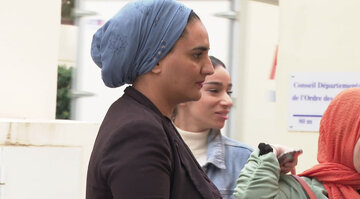
Amid escalating provocative electoral rhetoric and the growing influence of far-right currents, France is witnessing a fundamental shift in how its government treats its Muslim citizens. It is no longer just terrorism or extremism that is targeted for surveillance and restriction; French authorities have entered a phase of organized suspicion towards any public manifestation of Islam, to the extent that worship and the civil and social activities of Muslims are also being accused under labels such as "influence" and "separatism."
Hawaï Siniğer, a researcher on religion and politics in the Arab and Islamic world, in an article published on the French platform Orient XXI, believes there is much evidence of a policy of permanent suspicion towards Islam in France.
He argues that the French government has gone beyond countering extremist Islam and is now targeting almost any open expression of Islamic identity, even in its moderate and non-political forms.
Successive Laws and Intensified Restrictions
French Interior Minister Laurent Nuñez announced in May 2026 the drafting of a new bill to counter what is called "Islamist influence." This action came a few months after his attempt to prevent the annual gathering of the French Muslim Council in the Le Bourget area on the outskirts of Paris—an action justified on the grounds of security threats and potential disruption of public order.
Although the French administrative court halted this decision, the author believes the incident is a sign of increasing pressure against all manifestations of Islam in the public sphere.
The article then cites a series of French government actions, including the closure or restriction of educational institutions, focusing on the concept of "Muslim Brotherhood-ism," and introducing four legislative bills in less than a year. The French government, in line with closing or restricting Muslim educational institutions, terminated its contract with the Al-Kindi Institute in Lyon in January 2025. Also, the European Institute of Human Sciences (IESH) was dissolved in September of the same year on charges of promoting "Islamist ideology." The term "Muslim Brotherhood-ism," an indirect reference to the Muslim Brotherhood, has become a legal tool to target many independent Islamic institutions in France. Additionally, the French government has introduced four legislative bills against Muslims in less than a year, including a ban on hijab for minors in public places, a ban on religious symbols for local elected officials, and stricter laws related to separatism and Islamic influence.
The author believes that the pace of these restrictions has noticeably increased with the approach of the next French presidential election.
From Countering Political Islam to Suspicion of Muslims
The article emphasizes that the French public sphere is gradually rejecting any overt and visible presence of Islam. According to the author, this trend is rooted in Emmanuel Macron's speech in Les Mureaux in 2020, as well as the accusations of so-called "Islamo-leftism." These accusations, which also targeted universities and researchers, contributed to the formation of an atmosphere of distrust towards Muslims and researchers in fields such as immigration, discrimination, and post-colonial studies.
Siniğer writes, "The scope of suspicion no longer includes only terrorists and extremists, but also devout Muslims, social activists, and even researchers who challenge the official narrative about Islam."
He also points to the restrictions Muslims face in expressing their views. According to him, imams and religious officials are under immense pressure, and even speak cautiously about humanitarian issues like the Gaza war for fear of being accused of glorifying terrorism.
The author also believes that the French government views Islamophobia not as a form of racism, but merely as criticism of a religion, even as incidents of discrimination and attacks against Muslims are on the rise.
How Is the "Islamic Issue" Constructed?
The author cites the book "Islamophobia: How French Elites Construct the Islamic Issue" by Abdelaali Hajjat and Marwan Mohammed. These two researchers believe that assessing Islamophobia should be based on victim testimonies, surveys related to discrimination, and tests measuring discriminatory behavior.
It further states that the dissolution of the "Committee Against Islamophobia in France" (CCIF) in 2021 weakened the process of recording and documenting violations of French Muslims' rights. Furthermore, many victims are reluctant to file complaints due to distrust of the country's official institutions.
However, the French Ministry of Interior has announced that the number of anti-Muslim acts in 2025 increased by 75 percent compared to the previous year.
Official Report: Muslims Are the Primary Victims of Religious Discrimination
The article refers to a report published by French Human Rights Commissioner Claire Hédon in late 2025. This report shows that Muslims are more exposed to religious discrimination than any other religious group.
Part of the report states, "Reports of religious discrimination are significantly more frequent from individuals who identify as Muslim or are perceived as Muslim by others."
However, the report refrains from using the term "Islamophobia," using instead phrases like "hatred against Muslims" or "anti-Muslim behavior," because the term Islamophobia is not defined in French constitutional or criminal law.
Muslims: From Citizens to a "Threat"
The author warns that concepts like Muslim Brotherhood-ism, influence, and separatism have become part of French political and media discourse—a discourse that presents French Muslims as a cultural and demographic threat to the country.
He believes that some researchers and media figures have also played a role in reinforcing this atmosphere of suspicion, portraying Islam as an organized project to infiltrate French society.
According to Siniğer, the result of such an atmosphere is that any independent or critical activity by Muslims is viewed with doubt, and even the formation of a rational, French Islam compatible with society—something the French government itself had spoken of for years—has been hindered.
The author concludes that continuous pressure on French Muslims neither helps their social integration nor leads to greater cohesion, but rather makes Islamic identity a suspect and even shameful matter in the public sphere.
He emphasizes that the current policies of the French government do not distinguish between extremism and ordinary religiosity, and the effort to counter what is called "Islamic influence" has in practice created an atmosphere of permanent suspicion—an atmosphere reminiscent of dark historical periods in the treatment of minorities.