

ABNA24 - The developments of recent days in the Persian Gulf and reports of confrontations between IRGC and American naval forces have shown that in deeper layers of the ceasefire that followed the US-Israeli aggression on Iran on February 28, the military conflict has not stopped yet and actually war continues in the Persian Gulf in other forms that can be labeled the "war of wills."
Imposing a sea blockade on Iran to disrupt its trade, especially its oil exports and to open a secure sea route that will operate under its control in the Strait of Hormuz, the US is seeking to wrest from the Islamic Republic a powerful game card in this key waterway, a card that gives Tehran a determining position to frame the rules of engagement in this war of wills. On the other side, Iran's armed forces, utilizing special tactics that enable their full control over the strait and resolute power projection in dealing with the international navigation, are practically challenging the US Navy.
This issue sparked brief, intermittent clashes in the Persian Gulf over the past few days, pushing the ceasefire to the brink of collapse. Small as they may have been, these confrontations carried outsized consequences and messages.
Iran's resolve to confront US blockade: Tehran ready for rejuvenated war
The first message from the recent moves by Iranian armed forces in the Persian Gulf is that their fingers are on the trigger. Iran no longer sees the current situation as a ceasefire but as a continuation of hostilities, and that is the lens through which it responds to developments and movements by the US forces outside the Persian Gulf, especially the ongoing illegal naval blockade and actions against Iranian ships.
In a statement, the commander of IRGC’s Navy said: “Following the breach of the ceasefire and the aggression by the terrorist American military against an Iranian oil tanker near the port of Jask, and with American destroyers approaching the Strait of Hormuz, we carried out a massive and precision-coordinated operation, using a variety of anti-ship ballistic and cruise missiles as well as high-explosive warhead drones and opened fire on enemy destroyers.”
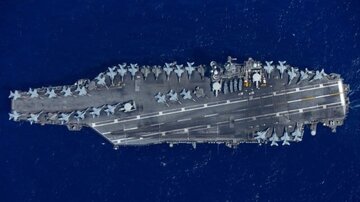
American news agencies described the attack as highly intense. CBS reported that the USS Truxtun and USS Mason were hit hard by Iran — describing the assault as more severe and sustained than the attacks targeting these vessels just days earlier.
New positions from Iranian military officials signal a determination to repeat these strikes, and even intensify them. In this vein, IRGC’s Aerospace Force Commander Brig. Gen. Seyyed Majid Mousavi stressed in a message: “Missiles and drones from the Aerospace Force are locked onto the enemy, waiting only for the order to fire.”
These developments and stances show that the Islamic Republic not only rejects the naval blockade and the pressure on its vital maritime routes, but also through flexing its muscles with firing warning missiles and drones sends a clear message that any push to turn the tide in the Persian Gulf will trigger direct, multilayered military response from the Iranian forces. The announcement that the missiles are locked on the targets is not a media show, but is part of the Iran's active deterrence strategy, which rests on readiness for fast transfer from alert to clash situation.
What unfolded on the ground only confirms this approach. American vessels approaching sensitive zones were met with a combined Iranian response, fast-attack craft, drones, and anti-ship missiles, proving that Tehran already has a ready-made operational plan in place to counter any scenario of gradual pressure or limited blockade. In other words, in this war of wills, Iran is not relying solely on verbal threats. It has demonstrated the ability to translate political resolve into battlefield action in record time. This very fact means any US calculation to apply calibrated pressure in the region's waters carries the risk of spiraling out of control, imposing heavy military and reputational costs.
From this perspective, Tehran’s core message is clear: the security of the Persian Gulf cannot be defined unilaterally, imposed from outside, or placed under exclusive US command. Any move to disrupt Iran’s energy exports or tip the balance of maritime traffic against Tehran will be treated as crossing the Islamic Republic’s strategic red line. Accordingly, Iran’s readiness for war is less about a desire to escalate and more about its determination to prevent war being imposed on it, while forcing the other side to accept the region’s new geopolitical realities.
Iran the only boss of Strait of Hormuz
Recent developments have highlighted the fact once more that the Strait of Hormuz is not just a trade route, but a field decisive in terms of geopolitics and security. It is a field in which Iran's will and operational dominance plays the key role. Though the US with naval presence, escort operations, and power projection tries to send the message to the world that it is capable of ensuring navigation in this significant waterway. But the field realities show that Iran still holds the initiative. Iran’s geographic position, coastal deployment, missile power, and the permanent presence of its naval and aerospace forces form a web of intertwined advantages, sharply limiting and controlling any external move.
For Iran, the Strait of Hormuz is not just a periodic pressure tool; it is part of the country’s strategic depth against extra-regional threats. That is why Tehran is sending a clear message to its adversaries, telling them that from now on, Iran will be the ultimate decider of the rules of engagement in managing the strait.
The recent clashes confirm this principle. Iran’s swift and decisive response to US destroyer movements and the attack on an Iranian tanker showed that Tehran not only has full intelligence awareness over developments in the strait, but also the will to act immediately on the ground. This level of dominance effectively prevents the US from unilaterally redefining shipping lanes to its advantage without reckoning with the region’s power realities. That is precisely why, every time Washington has tried to upend the post-war geopolitical rules of the Persian Gulf, through military posturing or psychological pressure, it has been met by Iran’s reaction and a return to Tehran’s smart management of the situation.
In such tumultuous conditions, the Strait of Hormuz remains Iran's most important strategic leverage in the war of wills, one that makes sense not just because of natural position of Iran, but also because of operational power of the Iranian armed forces. Therefore, while a superficial ceasefire may have reduced the intensity of direct confrontation, as long as Washington continues to try to limit Iran's role in the Persian Gulf and strip Tehran of its power to influence the Strait of Hormuz, this standoff will persist in various forms. What has taken place is a reaffirmation of a basic truth and it is that in the security equations of this key waterway, Iran is not a marginal actor but the main and decisive one.
/129


Your Comment