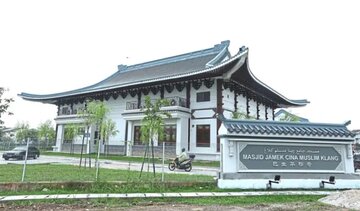
AhlulBayt News Agency (ABNA): The Klang Chinese Muslim Grand Mosque, located in the Taman Desawan Dua area, has gradually developed into a prominent hub for Islamic tourism in Malaysia’s Selangor state, despite being situated in a district with a relatively small Muslim population. With its distinctive architectural identity, inclusive cultural outlook, and community-centered approach, the mosque is defined as more than a place of worship, offering visitors an integrated experience of faith, heritage, and education.
Built on a 1.2-hectare site, the mosque meets the religious needs of local worshippers while being deliberately designed to welcome visitors interested in learning about Islam through architecture, history, and social engagement. Its presence in a multicultural neighborhood is widely seen as a symbol of the coexistence of Islamic institutions within a culturally diverse setting.
The mosque’s most striking feature is its architecture, inspired by traditional Chinese design, including curved roofs and a three-tier pagoda-style tower. According to the mosque’s imam, Adlu Kan Yong Sheng, the design draws inspiration from the Great Mosque of Xi’an in China. These features make it the first mosque of its kind in Selangor and have attracted growing attention from both domestic and international tourists.
The concept for the mosque was developed with the support of the Malaysian Chinese Muslim Association and the patronage of the Sultan of Selangor, Sultan Sharafuddin Idris Shah. To preserve architectural authenticity, field studies were conducted in China prior to finalizing the design. Construction began in late 2019 and, despite challenges posed by the COVID-19 pandemic, the project was completed and officially opened in August 2024.
Official figures show that by last December, more than 55,000 local and international visitors, including delegations from Australia, France, Germany, and Japan, had toured the mosque. The main prayer hall, which accommodates 350 worshippers and can be expanded to host up to 1,000 people, enables the organization of large-scale educational and cultural programs.
An Islamic art gallery featuring rare Chinese works, a café serving Chinese halal cuisine, and a range of cultural activities have further strengthened the mosque’s position as a symbol of intercultural dialogue and a key Islamic tourism destination in Selangor.
**************
End/ 345E