

AhlulBayt News Agency: In a meeting organized by the London-based Islamic Human Rights Commission (IHRC), Western states came under fresh criticism for their double standards on human rights and efforts to weaken the rule-based international order.
In the meeting dubbed "Genocide: Gaza, how did we get here?" coinciding with "Genocide Memorial Day" on Sunday, speakers examined the ongoing Israeli bloodshed and crimes in the besieged Palestinian territory amid Western silence.
Addressing the session, Raza Kazim of IHRC underscored that some political figures and media outlets in the West were seeking to erase the ground reality in Gaza from the public memory and even from historical record.
In this regard, he cited Mike Pompeo, the former US Secretary of State, who had emphasized the need for preventing Gazans being recorded as a "victim" in history, rather they should be presented differently.
"If you're not careful, the newspapers will have you hating the people who are being oppressed, and loving the people who are doing the oppressing," Kazim recalled a quote from Malcolm X, an African-American revolutionary and human rights activist, warning that the issue, today, is not limited to newspapers, but is also reproduced in political systems, and academic spaces.
Haim Bresheeth, a British writer and researcher, focusing on the role of media and power structures in the West, cited the BBC as an example of "deceptive media power," whose selective coverage of Gaza reminds the role media can play in concealing instead of revealing the truth.
Bresheeth then highlighted unprecedented dimensions of the Gaza crisis, in terms their visibility to the global public opinion, the level of technology used in the destructive actions, and the range of human and infrastructural consequences.
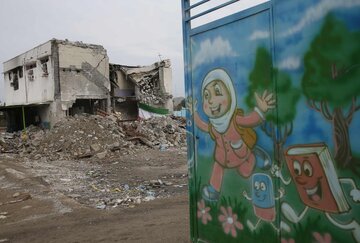
According to him, the dire situation is not only limited to bloodshed, but includes the destruction of infrastructure, medical and educational centers.
Ilan Pappé, a professor at Exeter University, in a speech titled "The Historical Context of Gaza," emphasized that to understand the current situation of Palestinians, one must look back to the past as how they were "erased and destroyed".
He said that Gaza was a vibrant city, where both Muslim and Jewish coexisted and lived peacefully before the events of 1948, adding that the harmony was destroyed with the widespread forced displacement that put pressure economic and social infrastructure of the city.
Pappé, by linking these developments to European history, said that the roots of "Zionist project" should be seen in the colonialism that gave rise to "the formation of extreme ideologies" and what happened in Palestine in 1948 was the continuation of the transfer European crisis to elsewhere.
He further stated that support to Israel and the shielding of its crimes by certain European governments, has exposed them to either indifference or complicity in the suffering of the Palestinian people.
At the end of the session, Ramón Grosfoguel, a professor at the University of California, raising the discussion of "settler colonialism and genocide" said that historical experiences in various parts of the world show that this trend is inherently linked to the violent removal of indigenous populations.
Citing instances in the Americas, Australia, and various other places, he said that in this "dehumanize" process, racist literature often provide the context of justifying violence.
Grosfoguel further stated that the so-called "international legal order" was collapsed in the test of Gaza, as Western powers that claimed be rule-based, had shown their selective approach to blatant violations these very rules.
......................
End/ 257


Your Comment