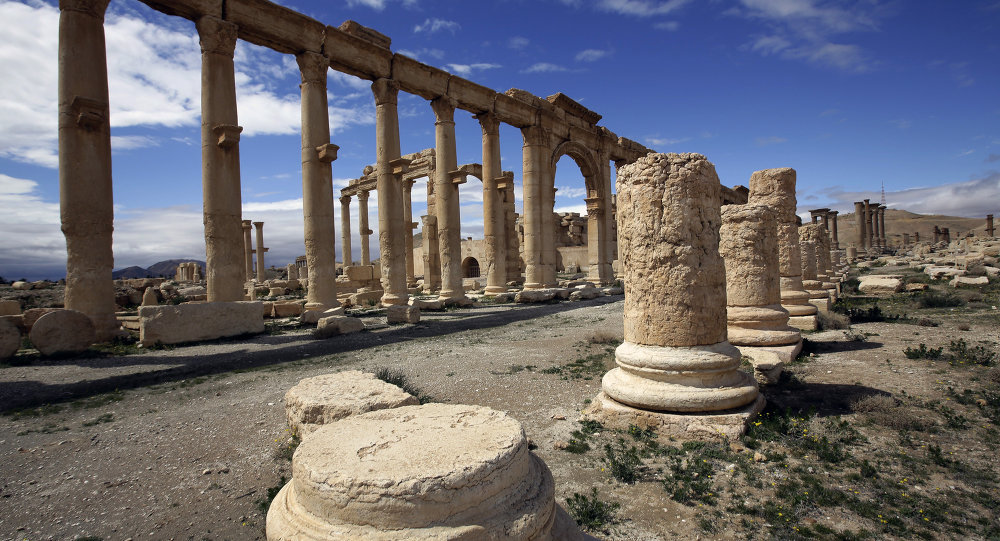
The historic city of Palmyra has fallen almost entirely under the control of the so-called Islamic State, after forces loyal to the Syrian president, Bashar al-Assad, collapsed under a seven-day siege that has left the magnificent ruins there exposed to near-certain destruction by the terror group.
Activists from the city and the Syrian Observatory for Human Rights, a monitoring group, said most of Palmyra fell on Wednesday shortly after the Assad forces evacuated most of its civilians and began withdrawing towards own strongholds in the west.
“The Islamic State organisation has now established almost complete control over the area from Palmyra to the Syrian-Iraqi border and onwards to the Syrian-Jordanian frontier,” said SOHR’s director, Rami Abdul Rahman.
The ancient city, once a Silk Road hub and one of the cultural centres of the ancient world that occupies mythological status in Syria, is home to some of the most beautiful and well-preserved ruins of antiquity, including the Temple of Bel, built in the first century.
Isis considers the preservation of such historical ruins a form of idolatry and has destroyed temples and historic artifacts, as well as ancient Assyrian sites in Nineveh in Iraq, after conquering the province in a lightning offensive last year.
The group has profited from looting historic treasures, in addition to scoring propaganda victories by the wanton destruction of archaeological sites, and Palmyra is likely to face a similar fate now.
The loss of the city and its surrounding gas fields, which supply electricity to much of the Assad government’s strongholds in western Syria, is another strategic defeat that could expose Homs and Damascus to the terror group’s advances.
Isis also appeared to have taken control of major facilities in and around the city, including the legendary military prison of Tadmur, the modern name for Palmyra.
The terror group advanced into the city after seizing its northern districts earlier in the day, backed by suicide bombers and artillery.
Palmyra is the second city to be seized by Isis in less than a week, after the militants routed Iraqi security forces in Ramadi, the provincial capital of Anbar province, highlighting the group’s resilience in the face of a US-led coalition air campaign and the limits of its strategy.
“Far from being degraded, Isis is still advancing in important areas – capturing Ramadi and Palmyra in the same week speaks volumes as to the group’s continued capabilities,” said Lister.
The director general of the UN’s cultural agency called for an immediate end to hostilities in the UNESCO world heritage site and for the protection of cultural heritage from direct targeting.
“I am deeply concerned by the situation at the site of Palmyra. The fighting is putting at risk one of the most significant sites in the Middle East, and its civilian population,” said Irina Bokova.
“I reiterate my appeal for an immediate cessation of hostilities at the site. I further call on the international community to do everything in its power to protect the affected civilian population and safeguard the unique cultural heritage of Palmyra.”
However, Isis has often cherished its destruction of cultural artifacts, releasing long, well-produced videos of their destruction of objects in the Mosul Museum and their detonation and bulldozing of much of the ancient fortress city of Hatra in Iraq.
Experts say the group benefits from its destruction of cultural heritage because it shows the militants can act with impunity and exposes the impotence of the international community in the face of the provocations.
Syria’s antiquities chief, Mamoun Abdulkarim, told AFP that hundreds of statues and artifacts from Palmyra’s museum had been transferred out of the city but many others, including massive tombs, could not be moved. Many of the city’s monumental ruins are too heavy to transport or consist of ancient buildings and architecture.