

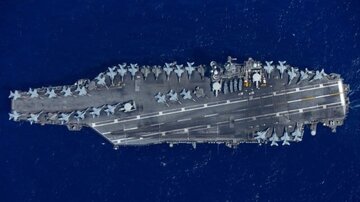
ABNA24 - The US military amasses a major portion of its naval capability including aircraft carriers, destroyers, nuclear submarines, and strategic bombers along with tens of thousands of forces around Iranian land and sea borders while the White House has only one day to the end of the 60-day period when the president can wage war without Congress authorization.
Meanwhile, regardless of the serious opposition of the Congress to the war and to the White House strategy about explaining the war goals and the ways out of it, the American public are obviously against extended aggression against Iran. Polls coming out show that nearly two-thirds of the Americans are against the war and only 20 percent or at most 25 percent of the Americans back the conflict. This includes polls by Reuters/Ispos conducted earlier in March and the last week poll by Strength in Numbers institute that suggested 55 percent of the American adult respondents want the US President Donald Trump be impeached.
So while anti-war senators have failed five times so far to stop the conflict, the pro-Trump camp’s razor-thin margin of victory, combined with deep Republican anxiety over how continued war support will play with voters in the midterms just five months away, is likely to make it much harder for the White House to secure congressional approval. In response, several Republican lawmakers, including Senator John Curtis and Representative Don Bacon, have signaled they may back restrictive measures if operations continue beyond the 60-day deadline.
War Powers Resolution
Under the 1973 War Powers Resolution, if a president sends troops into combat without a declaration of war or specific congressional approval, he must notify Congress within 48 hours. That triggers a 60-day clock, plus a 30-day withdrawal period for emergencies.
If Congress does not authorize the action, the law is clear: At the end of 60 days (or 90 including withdrawal), the president must pull forces out and halt operations, unless Congress has declared war, passed a military authorization (AUMF), or is physically unable to meet due to an armed attack on the US.
This law was born from the bitter clashes between Richard Nixon’s administration and Congress over the Vietnam War in the 1960s and early ’70s, a national trauma that remains seared into US’s collective memory. Beyond the massive atrocities American forces committed against the Vietnamese people, which left an indelible stain on the White House’s human rights claims, the military found itself trapped in a quagmire it could not escape, and ultimately had to flee in defeat, with nothing to show for it.
In that climate, Congress, feeling sidelined from war decisions, passed the War Powers Resolution by a two-thirds majority, overriding an initial presidential veto. The goal was to strike a balance between the president’s need to act swiftly and Congress’s constitutional oversight role.
The scenarios ahead of president for circumventing or extending the period
The lawmakers thought that this time frame will prevent the limited military actions from spiraling into full-scale operations. But there are still legal ways for the presidents to escape this restriction.
1. Limited interpretation of hostilities: Administrations mostly argue that their military actions are not hostility. Limited airstrikes or use of drones and logistical support fall under this argument. In Kosovo war of 1999, President Bill Clinton started a massive air campaign against Serbia, but argued these operations do not fall into the category of "hostilities" and according to this argument, it continued its attacks. In 2011 Libya campaign, Obama administration in a report to the Congress argued that the US participation in the NATO operations due to the limited role, use of long-range capabilities, and low risk to the American forces is not categorized as hostilities the way law describes.
2. Shift of nature of military action: The US administrations by re-labeling of the "war" to "humanitarian campaign", "advisory mission" or "fighting terrorism" claim that they initiate new missions and so their actions are exempted from restrictions.
3. Citing powers outside law: Presidents may argue that their powers under Article II of the Constitution, as commander in chief, override Congress’s statutory limits, claiming the War Powers Resolution infringes on executive authority. Administrations typically say their actions are “consistent with” the War Powers Resolution, not “pursuant to” it. “Pursuant to” means fully accepting the legal framework and triggering the 60-day clock. “Consistent with,” on the other hand, allows for political reporting without the administration conceding the law’s legal binding force.
Congress's options to revoke powers
The Congress has a highly powerful leverage, but use of it depends on political will.
1. Passing a resolution: By passing a resolution, the Congress may order fast withdrawal of the American forces. This resolution requires passing by two-thirds of the lawmakers, which looks unlikely at present.
2. Avoiding funding the government under "Power of the Purse" ability: Right now, that is the most powerful weapon Trump’s opponents in Congress hold. Lawmakers can explicitly write into spending bills that no funds may be used for military operations in target region. Without funding, continuing the campaign becomes effectively impossible.
3. Judicial instruments: Though the courts usually avoid involvement in foreign policy matters, the congressional lawmakers can, if law is brazenly violated, file legal suits, though success faces serious challenges.
In general, it must be said that though the War Powers Resolution may give the Congress the "off key" of the war, in practice it presents a political impasse. History has proven that when the Congress has no political will to challenge the president, this law can be easily sidelined by the government.
Therefore, it seems that after end of the 60-day period tomorrow, Trump will not face any serious legal challenge activating the additional 30-day period, though on the other side of story this will cost him and the Republicans their social and political support, something that can keep Trump from a new adventure.
/129



Your Comment