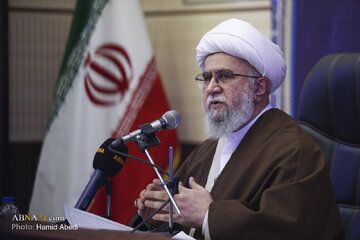
AhlulBayt News Agency (ABNA): Ayatollah Reza Ramazani, Secretary-General of the AhlulBayt (a.s.) World Assembly, on the occasion of the martyrdom of the Supreme Leader and Marja' of the Islamic Ummah, Ayatollah Sayed Ali Khamenei delivered a speech elaborating on the lofty character of the martyred Imam of the Islamic Revolution and the current and upcoming circumstances from both domestic and international perspectives.
Ayatollah Reza Ramazani, Secretary-General of the AhlulBayt (a.s.) World Assembly, on the occasion of the martyrdom of the Supreme Leader and Marja' of the Islamic Ummah, Ayatollah Sayed Ali Khamenei delivered a speech elaborating on the lofty character of the martyr Imam of the Islamic Revolution and the current and upcoming circumstances from both domestic and international perspectives.
Selected excerpts from the speech:
The discourse of the Islamic Revolution is rooted in the teachings of AhlulBayt (a.s.). The teachings of AhlulBayt (a.s.) call humanity toward Tawhid (monotheism) and, on the social level, toward the realization of justice – the thing that must be achieved in all dimensions of society. This aspiration is shared by all divine prophets, and it is precisely for this purpose that God sent them.
When the Islamic Revolution came into being, those who opposed it became enemies of the Revolution. They failed to adapt to this ideological framework and have consistently sought to undermine the Revolution.
In my view, the recent Fitnah (sedition or trial) is the most severe and difficult yet. It aims at the disintegration of the country. Although such attempts were made in the past, this time is different due to the direct involvement of America and Zionism.
Throughout all previous seditions, we have emerged victorious. Nevertheless, we have suffered significant material losses, and even more importantly, spiritual damage. The best among us have been taken – among them, the martyred scientists.
Our senior military commanders, each of whom embodied the moral character of an entire nation, were martyred during the 12-day war and in this brutal, savage attack. The losses are immense. In addition, numerous civilians and non-combatants were killed. The most painful aspect of this attack was the martyrdom of children who were present at school (in Minab). In total, 165 martyrs were killed. This issue demands international attention and follow-up, which will be addressed in the coming discussion.
This event ranks among the most severe and tragic calamities following the martyrdom of the martyred Imam Khamenei.
Internationally, there was a well-planned and premeditated scheme to assassinate him – a fact that later became clear to global public opinion. He was targeted at his workplace, located near his residence and in the presence of some family members. This incident stands as one of the most tragic and bitter events in this path.
Previously, certain media and propaganda outlets claimed he lived in deep, inaccessible underground shelters, making access to him impossible. However, the reality was entirely different. Government officials regularly visited his workplace, and daily meetings and official sessions were held there – located near his home.
This event also carried a clear message for many freedom seekers around the world: he lived not in isolation behind high security walls, but among the people, leading a simple life.
The martyred Leader, who lived a blessed life of 86 years, managed the Islamic system with utmost wisdom, politics, and piety until the final day of his life. His leadership spanned thirty-six to thirty-seven years – a duration that stands as an unparalleled or even unmatched example on the global stage.
We are witnessing a major event: an attack has been carried out and is still ongoing. Given the international standing of the martyred leader, how is this blatant act of aggression to be analyzed, and what contradictions does it present in relation to legal norms?
The first point to emphasize is that this aggression is, in the truest sense, a transgression, an overreach. It is directed against a country where the people are actively present on the scene. In the words of our late leader, this is a system in which democracy and religious democracy are established, where religion is present as substance, and the people are involved across all arenas in various forms. That said, it must be stressed that we are not claiming perfection in the realization of our ideals; there are challenges, some natural, others imposed, that officials are working to address.
The most important point is that our people remain present on the scene and play a fundamental role in all elections. Even the selection of the leader is carried out indirectly through a body of experts, who are qualified to assess the requirements of leadership, and their choice is made based on their jurisprudential credentials. Thus, leadership is indirectly chosen by the people.
This revolution rests on three main pillars: its Islamic character, the people, and the leadership. Currently, amid the war, the presence of the people across various arenas is evident. In the capital, Tehran, both military and residential areas are being bombed, resulting in the deaths of military personnel and civilians alike. Statistics indicate that by the seventh day of the war, 3,400 non-military sites had been targeted, a matter that demands thorough legal scrutiny. This is outright aggression, and international organizations, which have consistently claimed to uphold the rights of the aggrieved, must step in.
What crime have schoolchildren and civilians committed? Even if we assume that military installations are being targeted, what offense have these people committed? Under international law, there is no justification for the use of force or aggression. Iran was not the initiator of any attack, but it considers self-defense its right. The United Nations and its member states are obligated to condemn and prosecute the aggressors; failure to do so would make them complicit in the crime.
One of the dimensions of this aggression is the martyrdom of a source of emulation, the Supreme Leader, who had a religious and political base.
Given the martyrdom of a figure of this stature, all of his followers and adherents, as the legal guardians of his blood, are duty-bound to condemn the aggressive acts and bring the aggressors to justice. The aggressors and the territories from which they operate must not be allowed to feel safe. This heinous act of aggression has inflicted the gravest tragedy upon the Ummah, and all are obligated to fulfill their duties and responsibilities.
At present, we are facing two fronts: the front of truth and the front of falsehood. The front that claims to represent civilization, the so-called West, asserts its civility, yet the system of domination cannot be considered a genuine civilization. Indeed, if the term “civilization” is to be used, what they offer is a civilization of barbarism cloaked in its own distinct rhetoric.
These fronts are fundamentally unaccustomed to logic and dialogue; for them, dialogue and reason serve merely as pretexts. Even in negotiations, their objective is not to accept our positions, but to entrench discrimination, amass wealth, and establish global hegemony. For them, power is not a means of serving humanity, but an instrument for imposing global dominance and acting as the world’s self-appointed overseer.
Across Europe and Latin America, many governments have refused to provide military bases to the United States, with some openly opposing it.
The global media landscape, in terms of hardware, is under the control of the adversary, promoting false narratives. These narratives include claims such as “Iran has developed a nuclear bomb” or “Iran is suppressing its protesters,” thereby seeking to justify preemptive strikes.
Today, even non-Iranians around the world are organizing massive demonstrations against the Zionist regime. This reflects the awakening of today’s generation, a phenomenon that warrants particular attention.
If these narratives are conveyed accurately, dormant consciences will stir, and a vast resistance movement will take shape across the globe. The blood of the martyred leader is a force for transformative change; an effect rooted in divine tradition that will lead to the destruction of oppression and set the stage for the establishment of justice in the world.
Given the depth and scope of these matters, it can be said that we are engaged in a civilizational conflict. The discourse being advanced is one rooted in divine and human principles; it calls humanity toward monotheism and absolute truth, while simultaneously emphasizing justice, humanity, and humanitarian values.
In contrast, Western civilization, as it claims to be, in practice distances itself from ethical and human principles, deriding values such as justice and freedom. This civilization threatens nations and considers itself above international law, whereas the people of Iran, with five to six thousand years of history, have never surrendered to threats and have always stood firm against humiliation and coercion.
Today, two discourses are in opposition globally: 1. A discourse founded on colonialism, exploitation, discrimination, injustice, the subjugation of nations, and racial supremacy. 2. A discourse founded on rationality, spirituality, justice, austerity, and service to society.
The leaders of the first discourse are sources of moral corruption and barbarism, seeking to impose their global domination. In contrast, the leaders of the divine and human-centered discourse, such as the martyred leader of the revolution, are characterized by trust in God, faith, the pursuit of justice, austerity, and service to humanity. His family, too, lives modestly, and even valuable gifts are, before entering his home, donated to the museum of the shrine of Imam Reza (a.s.).
These characteristics reflect a spiritual, divine leader at the height of power and responsibility.
Some had assumed that in the face of foreign attacks, the people would not take to the field. Yet when the threats began, the people stepped forward on their own, standing against the nation’s enemies.
The Iranian nation, a great and honorable people, will never allow foreigners to enter the country and seize sovereignty. This awareness and resilience have been demonstrated by the nation since the inception of the revolution, and this blessed resolve will once again prevail.
**************
End/ 345