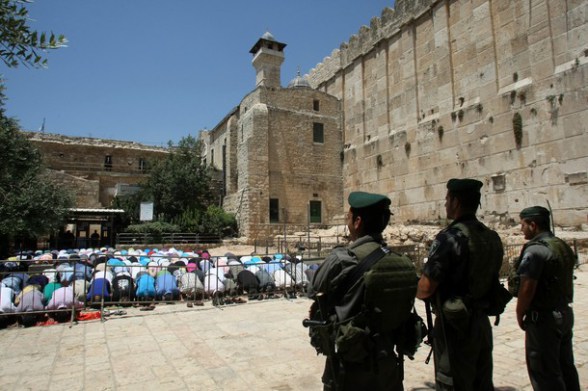
AhlulBayt News Agency - The Ibrahimi Mosque, the second most prominent Islamic site in Palestine, is located in Al-Khalil (Hebron), south of the West Bank, and is facing unjust Israeli measures.
Since 1967, the Mosque, also known as Al-Haram Al-Ibrahimi, has been encountering fierce Israeli attempts to distort and steal its cultural background. This include the Israeli massacre in 1994 that targeted the Palestinian worshipers in the Mosque, killing 40 of them and injuring tens others.
However, regardless of the religious, historical, and political importance of the Ibrahimi Mosque, the Israeli Judaization attempts are met with an Arab and Islamic silence.
Historical background
The Ibrahimi Mosque has such a long history according to different encyclopedias and historians. Adnan Abu Tabbana, professor of Islamic history, said that the story behind the Mosque started as Ibrahim (Abraham) –peace be upon him– arrived in Palestine as an asylum. The Canaanites were the residents of Palestine back then and he stayed in their lands for years.
Sanctuary of Abraham
Around 3800 years ago, Ibrahim took a cave under the Mosque to bury his wife, Sarah, and he was later buried there along with the Isaac, his wife, Jacob and his wife.
Abu Tabbana pointed out that this cave became vulnerable to collapse over time. Therefore, during prophet Suleiman’s era, a wall was built around the cave, with large stones, up to 10 meters in height and two meters in width. Some of these stones can still be seen in the wall surrounding the cave today.
Abu Tabbana added, “When Muslims conquered Palestine, they raised the wall and made the place a mosque. In the Umayyad era, Muslims built a ceiling for the place and started performing the Friday prayers there.”
Under the Crusade
Abu Tabbana stated that al-Khalil was severely inflected in 492 AH during the Crusade invasion and the Ibrahimi Mosque fell in the crusaders’ hands, turning it into a patriarchate, and calling it Saint Abraham and it carried that name for 90 years until Salah Eddin al-Ayyoubi conquered Palestine and demolished the castle they built inside the Mosque.
Religious significance
The Ibrahimi Mosque is particularly importance for Muslims as a burial for a number of prophets. Sheikh Moahmmed Muswaddi, Mufi of al-Khalil, said, “The Mosque enjoys a religious importance among Muslims as the place of the first Muslim, prophet Ibrahim, peace be upon him.”
Israeli violations
Numerous Israeli transgressions and attacks have been inflicted on the Ibrahimi Mosque. The director of the Palestinian-controlled part of the Ibrahimi mosque, Munthir Abu al-Feilat, said, “Palestinians controlled the Ibrahimi Mosque since 1967 until the 1970s, as Moshe Dayan entered the Mosque to the Ibrahimi cave. The entrance of the cave was then closed and the Israeli violations increased. In 1976, Israeli settlers burnt a copy of the Quran in the Mosque, triggering protests and clashes between Israeli settlers and Muslim worshipers.
In 1987, the Israeli regime installed electronic devices and metal-detectors on the main three entrances to the Mosque.
Abu al-Feilat added, “1994 was a tragedy in the history of the Ibrahimi Mosque as the extremist Israeli settler, Baruch Goldstein, committed a massacre that killed 29 Palestinian worshipers in the Mosque.”
Shamgar Commission
Following the massacre, the Israeli regime formed an inquiry commission, which divided the Mosque into two parts: 56% for Jews, and 44% for Muslims.
Since the division, Muslims have control over their part from 3 am to 9 pm, except for the ten days of Jewish holidays and festivals, as the Jews take the control over the whole Mosque.
/129