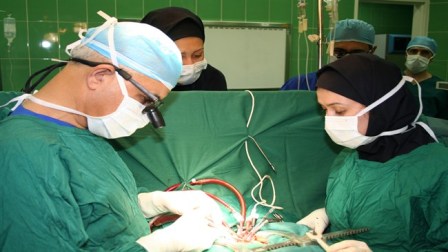
According to Iran Daily, Bahar Ashjaei made the announcement in an exclusive interview with the daily made on the sidelines of the 23rd Congress of Iranian Society of Pediatric Surgeons which was held at Tehran’s Razi Congress Hall from May 16-20.
The gathering was focused on neonatal surgery and surgical care of newborn, Ashjaei said.
“Sixty articles on topics, including surgeries of newborns with congenital birth defects, surgeries for acquired diseases of premature infants, surgeries to correct developmental anomalies in neonates and the role of post-surgery nursing and incentive care services to improve the health status of newborns were presented at the event by the participants,” Ashjaei also secretary of the annual event said.
In addition, four scientific roundtables were held during the event to discuss the latest methods for infants’ surgical treatments.
Noting that Iranian specialists have made remarkable achievements in infants’ surgeries, she added two presentations reported on the technically advanced, expensive and still very rare surgeries: non-invasive surgery and fetal open surgery.
“The prompt diagnosis of prenatal growth deficiencies was not possible in the past due to lack of medical progress and facilities. This increased the rate of birth defects and mothers with stillborn infants,” she noted.
Ashjaei said specialists can operate on babies in the womb to diagnose and treat deficiencies, including disorders of nervous, digestive and urinary systems, which could increase the risk of stillbirth and defects, in case they remain untreated.
“Although life-saving corrective surgeries can be performed in the first months after birth, certain surgeries should be conducted in the womb — at a particular time — to save both mother and child,” she said.
The specialist added that two surgical techniques, namely non-invasive and open surgeries, are conducted on fetuses in only a few countries.
“Iran is among few countries that have gained access to the latest surgical technologies,” she said.
The specialist explained the difference between non-invasive and open surgeries as follows:
Open surgery is when the fetus is out of the womb to undergo the required surgery. After the surgery is completed, the fetus is put back inside the womb.
Non-invasive technique is when specialists use special tools with cameras by inserting them into fetus body through small-sized cuts to find the problem and remove it.
In case an unborn baby is diagnosed with a developmental problem that needs a non-invasive surgery, the surgery must be performed on the fetus at 22-24 months.
The symptoms for birth defects are not recognizable in fetuses under 22 months. Besides, fetus is too small under 22 months which makes surgery difficult and impossible.
Ashjaei said non-invasive surgeries are still very rare in the world because of high expenses, lack of equipments and skilled surgeons.
“We have skilled surgeons to do such operations. However, such operations are rarely conducted because birth defects are rare in the total population,” she said.
The university instructor said Iranian specialists apply the world’s latest methods of surgeries to correct the problems affecting children’s urinary and digestive systems.
“Hirschsprung’s disease affects the nervous system in abdomen and leads to digestive problems in children. In the past, Iranian surgeons had to perform consecutive surgeries on the patients, which were accompanied with bleeding,” she said.
“Today, such a disorder is removed through only one surgery and without any cut and bleeding, thanks to Iran’s great achievements in medical sciences.”
Ashjaei concluded that several scientific congresses are held nationwide to upgrade domestic surgeons’ knowledge and give them the opportunity to get acquainted with the world’s latest methods.
/149