

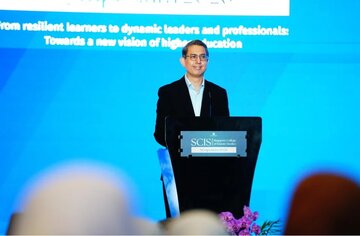
ABNA24 - Malaysian Islamic scholar and President of the Malaysian Consultative Council of Islamic Organizations (MAPIM), Mohammad Azmi Abdul Hamid, highlighted the legacy of the late Ayatollah Seyyed Ali Khamenei, describing his leadership as closely associated with the principles of dignity, independence, and strength in the Islamic world.
The Malaysian Islamic scholar and President of the Malaysian Consultative Council of Islamic Organizations (MAPIM), Mohammad Azmi Abdul Hamid, highlighted the legacy of the late Ayatollah Seyyed Ali Khamenei, describing his leadership as closely associated with the principles of dignity, independence,and strength in the Islamic world.
He made the remarks ahead of the funeral procession of the martyred Leader of Islamic Republic, Ayatollah Seyyed Ali Khamenei.
Speaking on the significance of Ayatollah Khamenei’s legacy, Azmi Abdul Hamid stated that Iran, under his leadership, consistently positioned itself as the voice of resistance against unilateral global power structures and as a defender of the Palestinian cause.
He noted that this approach contributed to shaping a distinct geopoliticalidentity for Iran and strengthened the discourse of sovereignty and resistance across the Muslim world.
The Malaysian activist and humanitarian leader emphasized that dignity, independence, and strength are fundamental components of Islamic civilization, adding that these values represent deeper civilizational aspirations rooted in justice and self-determination.
He stressed that genuine leadership is measured not only through governance but also through resilience under pressure, preservation of national sovereignty, and the ability to offer an alternative vision for the global order.
Azmi Abdul Hamid further noted that the legacy of Ayatollah Khamenei will continue to be discussed in political, academic, and religious circles, but its impacton the discourse of Islamic resistance and geopolitical independence remains undeniable.
He added that for many Muslims, Iran represents a symbol of steadfastness in confronting external pressures and defending the rights of oppressed people, particularly the Palestinian nation.
Concluding his remarks, Azmi Abdul Hamid stated that the discussions surrounding Ayatollah Khamenei’s legacy raise broader questions for the Muslim Ummah regarding the balance between sovereignty and cooperation, resistance and diplomacy, as well as identity and engagement with the wider world, issues that will continue to shape Islamic thought and political development in the years ahead.
/129


Your Comment