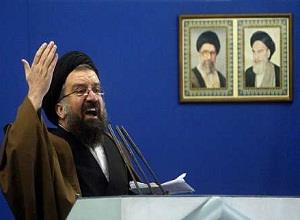
(Ahlul Bayt News Agency) - The prominent cleric referred to the EU foreign policy chiefˈs recent odd comment that the West will pursue the pressure and negotiation policies parallel with each other in dealing with Iran, said, ˈWe too, will by grace of God, pursue the down with USA and negotiations simultaneously.ˈ
He said it is the spirit of resistance that can best respond to the mixed messages received from Washington, adding, ˈIn the framework of the Supreme Leaderˈs guidance, which is prestigious, wise and expediency seeking (diplomacy), which is what heroic lenience means, we do not consider resistance contrary with that diplomacy.ˈ
ˈHere too, is a battle scene, and we say more power to your elbows to our countryˈs diplomats who are working in line with the Supreme Leaderˈs guidance, and clearly announce that so long as they try to implement the Supreme Leaderˈs intentions they are definitely supported by the nation,ˈ he said.
Khatami who is also a member of the Leadership Experts Assembly, said, ˈTherefore, to the world that is eager to know Iranˈs stands, I say to wait for November 4th (the anniversary of US Embassy seize by revolutionary university students), when they would by grace of God be witnesses to the more glorious chanting of the Down With USA slogans of the Iranians than ever before.ˈ
There are no formal diplomatic relations between Iran and the United States. Due to poor relations between the two countries, instead of exchanging ambassadors, Iran maintains an interests section at the Pakistani embassy in Washington, D.C., while the United States has maintained an interests section at the Swiss embassy in Tehran.
Relations between the two nations began in the mid-to-late nineteenth century. Initially, while Iran was very wary of British and Russian colonial interests during the Great Game, the United States was seen as a more trustworthy Western power, and two Americans, Arthur Millspaugh and Morgan Shuster, were even appointed as treasurers-general of the Iranian government by the Shahs of the time.
During World War II, Iran was invaded by Britain and the former Soviet Union, both US allies, but relations continued to be positive after the war until the later years of the government of Mohammad Mossadeq, who was overthrown by a coup organized by MI6 and aided by the Central Intelligence Agency.
This was followed by an era of close alliance between Mohammad Reza Shah Pahlaviˈs regime and the American government, which was in turn followed by a dramatic reversal and hostility between the two countries after the 1979 Iranian Revolution.
Opinions differ over what has caused the decades of poor relations. Iranian explanations include everything from the natural and unavoidable conflict between the Islamic Revolution on the one hand, and perceived American arrogance and desire for global hegemony on the other.
Since 1995, the United States has had an embargo on trade with Iran, which has increased ciontinually up to now, and coupled with the US encouraged EU and UN sanctions.
In January 1998, newly elected Iranian President Mohammad Khatami called for a ˈdialogue of civilizationsˈ with the United States in a CNN interview. In the interview, Khatami invoked Alexis de Tocquevilleˈs Democracy in America to explain the similarities between American and Iranian quests for freedom. American Secretary of State Madeleine Albright responded positively, and the countries exchanged of wrestling teams. This also brought freer travel between the countries as well as an end to the American embargo of Iranian carpets and pistachios. Relations then stalled due to opposition from Iranian conservatives and American preconditions for discussions, including changes in Iranian policy on Israel, nuclear energy, and support for terrorism.
The visit by President Hassan Rohani of Iran to New York City in September 2013 was hailed as major progress in Iranˈs relations with United States. Rohani previously said that his government was ready to hold talks with the United States after thirty two years. However, he rejected US President Barack Obamaˈs request for a meeting with him. On 27 September, a day after the two countriesˈ foreign ministers met during the P5+1 and Iran talks, Rohani and Obama spoke by telephone, the two countriesˈ highest political exchange since 1979. The call led to protests by Iranian conservatives who chanted ˈDeath to Americaˈ when Rohani returned to Tehran.
/106