

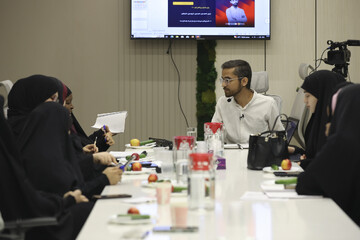
Ahlul Bayt (AS) News Agency - ABNA: Syed Samer Naghdali Al-Hakeem from Australia, a founding member of the Australian Muslim Adolescent Development and Education initiative, was among the speakers at the 9th International Pre-Meeting of the 6th Imam Reza (AS) Global Congress. He presented a paper titled “Family Rights and Their Significance in Imam Reza’s Teachings,” in which he explored the theological, social, and contemporary political dimensions of family in Islam and the challenges it faces today.
He began his speech by thanking the organizers of the event, the Imam of the Time (may Allah hasten his reappearance), and those who invited him to participate. He also congratulated the Iranian people on the anniversary of the great Islamic Revolution. Introducing his topic, he explained that when speaking about rights, Islam also speaks about obligations, and that it is impossible to discuss rights without addressing responsibilities and prohibitions.
Syed Samer noted that as one of the later speakers, some of his points might overlap with what others had already said, but emphasized that there is a shared root cause behind many of the challenges discussed during the pre-meeting session. Referring to the riots that hijacked protests on the 18th and 19th of Dey, he said it was necessary to examine at least one possible reason why such events occurred. According to him, the issue goes back to understanding the importance of the family and recognizing how enemies are targeting it. He stressed that the family is the fundamental building block of society, and that dismantling the family ultimately means dismantling society itself.
He argued that enemies are deliberately targeting young women and youth, describing them as the greatest assets of any nation and the future leaders of society. He said that while methods include attacking food, energy, language, and culture, in the end times the main targets are women and youth. He emphasized that such efforts are planned decades in advance, not spontaneously.
As an example, Syed Samer referred to Agenda 2030, signed by United Nations member states in 2015. He explained that on the surface the agenda appears positive, with 17 goals and 169 targets such as eliminating poverty and hunger, promoting health, education, gender equality, clean water, and sustainable energy. While these goals sound appealing, he warned that a deeper look reveals an attack on the foundations of religion and society, particularly Islam. According to him, the agenda seeks to dismantle the building blocks of society so that once these foundations are removed, new social norms can be imposed and dictated.
He highlighted the fourth and fifth goals of Agenda 2030, related to education and gender equality. He pointed out that while Arabic translations use male and female terminology, the intended meaning goes far beyond biological distinctions. Instead, he said, gender is presented as a spectrum, where traditional male and female identities are portrayed as extremes, and fluid identities in between are normalized. He explained that children are taught from as young as five years old about human rights, and while Islam fully supports human rights and dignity, the definition promoted under these frameworks is fundamentally different from that of the Quran, the Ahlul Bayt (AS), and Imam Reza (AS).
Syed Samer warned that despite objections raised by Iran’s Supreme Leader, these ideas are still gradually entering the Iranian education system, and awareness is needed to prevent this. He identified three main areas being targeted: the family, gender roles, and sex education. He explained that children are systematically introduced to these concepts through staged educational programs from early childhood into adulthood. By ages nine to twelve, sex education is introduced under the banner of human rights, teaching children that whatever they feel is valid and protected, and that opposition can be legally punished. He cited examples from Victoria, Australia, where parents, doctors, or teachers can face heavy fines or imprisonment for questioning a child’s expressed identity.
He argued that such education strips children of self-evident truths, and once those are removed, any belief can be imposed. He warned that these practices are already entrenched in Western societies and are now beginning to infiltrate Iranian society as well. He described how workplaces in the West enforce ideological conformity, even in basic communications.
Emphasizing the Islamic view, Syed Samer stressed that family is central and clearly defined. He said that Islam recognizes the nuclear family formed through the marriage of a man and a woman who raise children together. He cited the Quranic verse:
هُنَّ لِبَاسٌۭ لَّكُمْ وَأَنتُمْ لِبَاسٌۭ لَّهُنَّ
“Your spouses are a garment for you as you are for them.” (Surah Al-Baqarah, 187)
Turning to gender rights, he addressed what he described as a major fallacy promoted among young people, including Muslims: the idea that men and women must be identical in all aspects. While equality in dignity and rights is valid at a human rights level, he said the problem arises when biological, emotional, and spiritual differences are ignored. He explained that men and women possess different manifestations of divine attributes, and together they complement one another. He referred to narrations stating that marriage protects half of one’s religion, emphasizing that marriage is a means of spiritual completion when pursued for the sake of Allah.
He argued that weakening family structures leads directly to social disorder, citing examples of young teenagers being left on the streets during unrest. Drawing from his own academic experience, he stated that Islam places profound emphasis on women, to the extent that it could almost be described as a religion centered on women’s dignity and rights. He referenced Allama Tabataba’i’s Tafsir al-Mizan, particularly in Surah al-Nisa, to highlight the honor and dignity granted to women in Islam.
He quoted the Quranic verse:
ٱلرِّجَالُ قَوَّٰمُونَ عَلَى ٱلنِّسَآءِ
“Men are the caretakers of women.” (Surah An-Nisa, 34)
He explained that this verse is often culturally misrepresented as domination, whereas the continuation of the verse clarifies its meaning:
بِمَآ أَنفَقُوا۟ مِنْ أَمْوَٰلِهِمْ
“Because they spend from their wealth.”
He interpreted this as a command for men to support women financially, emotionally, and socially, providing shelter, security, and provision according to their status. He cited a saying of Imam Reza (AS):
صاحِبُ النِّعمَةِ يَجِبُ أن يُوَسِّعَ عَلى عِيالِهِ
“The person who has a blessing should be generous to his family.”
He emphasized that in Islam, financial responsibility lies with men, while women are not obligated to work or spend their wealth. At the same time, he acknowledged that women may choose to work and have a place in society, but if they choose to remain at home to raise children, this role is honored as raising the Islamic Ummah.
Addressing the issue of sex education, Syed Samer noted that due to limited time he could not elaborate in detail, but emphasized that such programs ultimately aim to erode haya, or modesty. He criticized educational approaches under the Agenda 2030, that introduce children to discussions about physical interaction, personal boundaries, and consent at ages as early as under 18, while at the same time restricting or delaying marriage until after the age of 18. He concluded that, in his view, Agenda 2030 stands in fundamental conflict with Islamic faith and cultural values.
In closing, he highlighted two core differences between Islamic teachings and contemporary global agendas. First, Agenda 2030 is based on an exclusively material worldview, while Islam views the human being as both material and spiritual. Second, while Islam is centered on tawhid and the worship of Allah, such agendas ultimately promote the worship of desire. He thanked the audience for listening and concluded his remarks.


Your Comment