

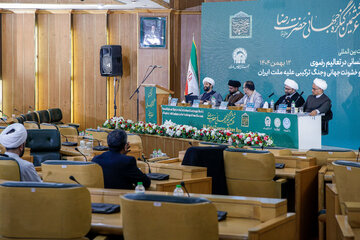
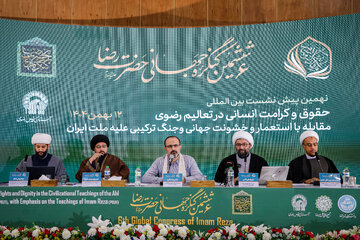
Ahlul Bayt (AS) International News Agency - ABNA: The 9th International Pre-Meeting of the 6th Imam Reza (AS) Global Congress featured a presentation by Shaykh Muhammad Husayn Taqi Nakhid, an international propagator on Islamic matters active in the United Kingdom, Grenada, Barbados, and Trinidad and Tobago.
Shaykh Nakhid opened his speech with the Quranic verse: لَقَدْ خَلَقْنَا ٱلْإِنسَـٰنَ فِىٓ أَحْسَنِ تَقْوِيمٍۢ, Indeed, We created humans in the best form. He explained that his paper focused on three principles illuminated by the life of Imam Reza (AS): self-respect, free thinking, and resistance. He said he chose this topic because it resonates with contemporary challenges, asserting that by examining the life of the eighth Imam historically and applying his teachings to modern life, these principles become practical obligations.
Shaykh Nakhid emphasized that the Holy Prophet (PBUH) left two weighty sources for guidance: the Holy Quran and the Ahlul Bayt (AS). He noted that lessons from the lives of the Ahlul Bayt (AS), particularly Imam Reza (AS), are directly applicable today, reflecting the realities of the Islamic Republic of Iran and the leadership of Syed Ali Khamenei.
On self-respect, or Izzat un Nafs, Shaykh Nakhid referred to Surah Tin, verse 4, stating that humans were created in the best form, higher than other creations, as a divine instruction to uphold dignity and honor. He cited other Quranic references: “We have honored the children of Adam,” emphasizing that self-respect is mandated by Allah. Drawing from the life of Imam Reza (AS), who maintained his dignity under the Abbasid Caliphs, Shaykh Nakhid illustrated contemporary application, quoting the Supreme Leader: “If you hit us, we will respond,” showing that independence and dignity are essential and that past colonial subjugation has ended. This, he explained, is the essence of Izzat un Nafs: asserting rights and responding proportionally to aggression.
The second principle, Hurriyatun Fikr, or free thinking, Shaykh Nakhid emphasized through Quranic verses urging reflection and use of intellect (يَعْقِلُونَ) (أَفَلَا يَتَدَبَّرُونَ). He highlighted that Imam Reza (AS) promoted debate and scholarly interaction, encouraging questions rather than passive acceptance. In modern times, the Supreme Leader similarly challenges followers with questions such as: “Are you afraid of martyrdom? Are you afraid to be imprisoned? Are you afraid to be held by the authorities for standing up for what is right?” Shaykh Nakhid explained that these rhetorical challenges echo Quranic guidance to exercise intellect and not follow blindly. He contrasted this with the West, noting unquestioning obedience to leaders like Trump, where a president could capture another nation’s leader without accountability. Shaykh Nakhid argued that free thinking, as taught by the Quran and Ahlul Bayt (AS), requires questioning, reasoning, and forming independent opinions, even in the face of authority.
The third principle, resistance, Shaykh Nakhid illustrated through Surah Baqarah, verse 190: وَقَـٰتِلُوا۟ فِى سَبِيلِ ٱللَّهِ ٱلَّذِينَ يُقَـٰتِلُونَكُمْ وَلَا تَعْتَدُوٓا۟ ۚ إِنَّ ٱللَّهَ لَا يُحِبُّ ٱلْمُعْتَدِينَ, Fight in the cause of Allah ˹only˺ against those who wage war against you, but do not exceed the limits. Allah does not like transgressors. He cited the 12-day Iran-Israel war, noting the Supreme Leader’s guidance to respond proportionally, without exceeding limits. He also drew lessons from Imam Ali (AS), who when attacked by Ibn Maljam, instructed that he be struck only once, demonstrating moderation, justice, and adherence to divine principles. Shaykh Nakhid highlighted that Allah encourages balance in life, avoiding extremes (ifrat or tafreet), and that moderation aligns with the teachings of Imam Reza (AS).
Shaykh Nakhid concluded that self-respect, free thinking, and resistance, though derived from historical contexts, remain essential today. By applying these principles, individuals can live in accordance with the teachings of Imam Reza (AS), the Holy Quran, and contemporary leaders like the Supreme Leader and Imam Khomeini (RA). He emphasized that while respect is due to all Maraja and Ulama, in matters of Wilayat al-Faqih, the guidance of the Supreme Leader reflects the principles of the Ahlul Bayt (AS) and the Quran. Shaykh Nakhid urged followers to implement these three elements in personal, family, and generational life, ensuring that the lessons of Imam Reza (AS) continue to guide society today.


Your Comment