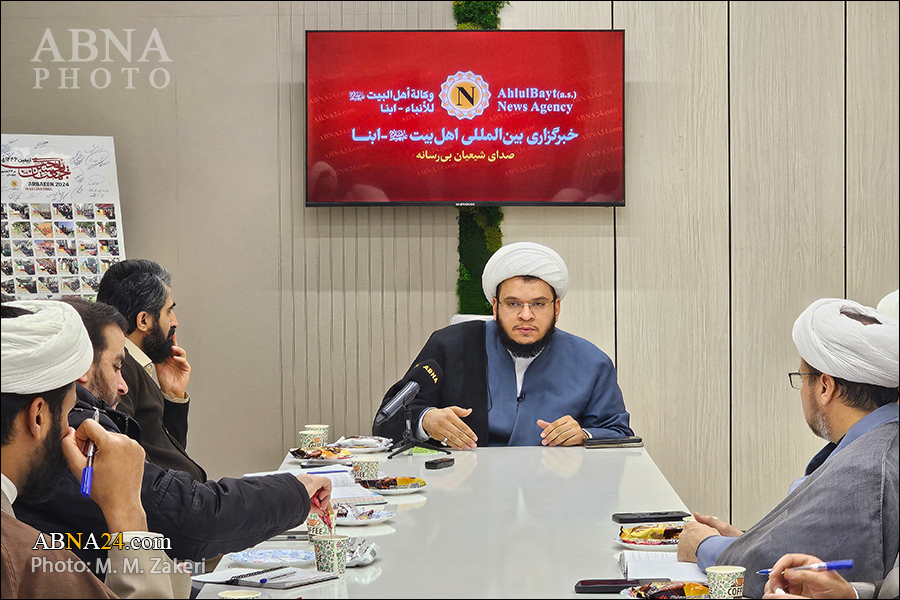
AhlulBayt News Agency (ABNA): A specialized meeting titled “The Future of Syrian Shiites in the Current Transformational Atmosphere” was presented by Hojat al-Islam Mohsen Nakhaei, the head of the representative office of the AhlulBayt (a.s.) World Assembly in Syria. This meeting was organized by the Office for Studies and Research of the Department for Scientific and Cultural Affairs of the AhlulBayt (a.s.) World Assembly and held in the conference hall of ABNA News Agency.
Fighting the Zionist Regime Based on Ethical Principles
Hojat al-Islam Mohsen Nakhaei, referring to the history of the crisis in Syria, stated, “This country has been dealing with internal issues for about 13 years. The crisis in Syria began in 2011 with popular protests, which gradually turned into military confrontations. The approach of the resistance forces in Syria was to strengthen the fight against the Zionist regime based on ethical principles, emphasizing the avoidance of targeting civilians or facilities such as medical centers during conflicts.
“However, in recent Syrian events, no protests took place, and we witnessed a change in the methods of opposition groups. Instead of using intimidation tactics, they turned to interacting with people. Some interpreted the swift takeover of various cities, even Damascus, by opposition forces as a surprising development. A heavy media propaganda campaign accompanied these transformations, and we witnessed an intense media war,” he added.
Syrian Shiite Refugees in Need of Humanitarian Aid
The head of the representative office of the AhlulBayt (a.s.) World Assembly in Syria added, “Immediately after the ceasefire in Lebanon, opposition attacks began on areas under the control of Bashar al-Assad’s government. Some believe there was coordination between the Zionist regime and the armed groups in these attacks, particularly after the regime destroyed all military infrastructure that belonged to the nation. In this sudden and comprehensive advance, crisis management was necessary for the situation of minorities, especially Shiites, as concerns regarding their status arose.”
Highlighting the situation in the Sayyidah Zaynab (a.s.) region, Nakhaei stated, “After the opposition entered the Sayyidah Zaynab (a.s.) area of Damascus and due to the ongoing chaos, thefts occurred at the holy shrine of Lady Zaynab (a.s.) and the offices of Iranian and Lebanese institutions in the area. However, the new rulers announcing that they did not approve of these actions and that their forces did not carry them out, took measures to ensure the security of sacred sites.”
“In a statement issued after the fall of Bashar al-Assad’s government, Sayed Abdullah Nizam, the head of the Council of Shiites Scholars in Syria, assured the Syrian Shiites that they were not in danger. However, a few days later, another statement from him emerged, emphasizing that he could no longer guarantee anything and that each Shiite Muslim could decide based on his interests. This caused concerns in the Shiite community of Syria and led some Shiites to leave the country. Recently, however, he issued another statement emphasizing calm and collective participation,” he continued.
The head of the representative office of the AhlulBayt (a.s.) World Assembly in Syria added, “The conditions of Syrian Shiites are different from those of Lebanese Shiites. Currently, some Syrian Shiites are present in the Beqaa region of Lebanon. Although most Syrian Shiites have not left the country, the displaced Shiite population needs humanitarian aid.”
Allama Amin: A Successful Example of Religious Promotion in Syria
Nakhaei, commenting on the future of Syrian Shias, stated, “We must wait for stability in Syria, and meanwhile our duty is to safeguard the Shiites of the country. Additionally, we must work to strengthen Shiite presence and participation and preserve their rights in the new era of Syria across various dimensions. By advocating for a peaceful environment, we should encourage the return of displaced Syrian Shiites, hoping that with stability in Syria, conditions will improve. During the Assad reign, the areas inhabited by Syrian Shiites were not prioritized by the government, and Shiites suffered from restrictions imposed by the government.”
“The state of bewilderment among Syrian Shiites after the Assad government was due to their lack of familiarity with the new regime. The central residence of Shiites in Damascus is in the neighborhoods of Amin, Imam Sadiq (a.s.), and Imam Zain al-Abidin (a.s.). The offices of the Sources of Emulation religious in Syria are concentrated in the Sayyidah Zaynab (a.s.) region of Damascus, where the offices of figures such as Grand Ayatollah Khamenei, Grand Ayatollah Sistani, the late Grand Ayatollah Sayed Mohammad Saeed Hakim, and the late Allama Fadlallah are located. The Shiite population in Syria is estimated to be around 350,000, residing not only in Damascus and the Sayyidah Zaynab (a.s.) region but also in areas such as the cities of Nubl and al-Zahraa, Foua and Kafriya, Homs, and Hatla in Deir ez-Zor. Over 75% of Syria’s population consists of Sunni Muslims,” he continued.
At the end of his speech, he noted, “We should learn from the experiences of Imam Musa Sadr. Imam Musa Sadr connected with the masses and carried out cultural and institutional work. Allama Sayed Mohsen Amin is another successful example in the field of religious propagation. The Amin neighborhood in Damascus, previously known as the “Ruined District” before Allama Sayed Mohsen Amin settled there, was transformed through his efforts. This great scholar undertook infrastructural projects and established various institutions.”
**************
End/ 345