

ABNA24 - About a month after start of the Israeli-American military aggression against Iran with the aspiration of establishing “Greater Israel” through toppling the Islamic Republic and partitioning Iran to smaller states, the evil plan has began to backfire and the aggressors, desperate in words and actions, are seeking a way out of the quagmire with less humiliation and costs to their image.
Meanwhile, Trump who compared to Netanyahu sees himself the main loser in this conflict is struggling to secure a minimum of battleground gains, and in his tumultuous mind he sees the boots on the ground on the Iranian island of Kharg in the Persian Gulf as the way out of certain defeat and a point for victory in the war. Though the Israeli forces may probably be in the American mission for potential deployment to Iran, the very dream of attacking and seizing Kharg faces major obstacles that can be Trump's most dangerous and last mistake should they be ignored. Here are they:
1. American forces unmotivated and afraid: The military forces, especially those set to fight on the ground, need strong motivation and morale for fighting. This does not merely come from military orders. They need faith in what they do, which is a determining factor. That is why the Americans before any aggression on other countries first talk about existing threats and then spread lies against the country they want to invade. This was obvious in Iraq and Afghanistan wars. While the US initially launched its assault on Iran under the guise of fabricated threats to its interests, events soon took a dramatically different turn. The landscape shifted, fueled by the proliferation of social media, a burgeoning public awareness, and Donald Trump’s notorious reputation as a mendacious, narcissistic, and power-hungry president. Compounding this, the US military’s top brass harbored a deep reluctance to engage Iran due to insufficient readiness. Consequently, American forces, particularly those earmarked for a potential assault, found themselves gripped by profound fear and demotivation. This internal crumbling was exacerbated by Iran’s relentless, heavy-handed, and devastating retaliations against US bases in the region, which are witnessed firsthand by these troops, resulting in numerous casualties and prompting waves of desertions to civilian areas across the Persian Gulf Arab states. These events shattered their morale, painting a grim picture of their impending fate and undermining their resolve. No one relies on a soldier already brought to their knees for war. In stark contrast, Iran’s valiant and highly motivated fighters eagerly await such a confrontation.
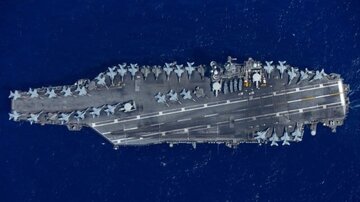
2. Serious vulnerability of military equipment: The main reliance of the US in its wars is on the advanced weapon systems and among the American presidents in recent decades, Trump is the biggest boaster of these weapons. Trump has always bragged about the US army being the world's most powerful military, and by intimidating others he has sought to attract clients to the American arms like a merchant, making relative successes. This picture changed all of a sudden. Before aggression against Iran, Trump boasted about "beautiful" and powerful "armada" spearheaded by USS Abraham Lincoln and USS Gerald R. Ford aircraft carriers, proudly selling the idea of their invincibility to the global, especially Iranian, public. But this turned into a humiliation soon. Briefly after deploying for operation and facing Iran's missile power and sustaining heavy damage from Iranian attacks, which many analysts said they were reduced to fishing boats, they fled the region, leaving Trump in an embarrassing position. Instead of boasting about their power and grandeur, Trump shamefully admitted that the US's $13 billion USS Gerald R. Ford, which is the world’s largest and most expensive aircraft carrier, fled the battlefield to spare American soldiers from death due to severe damage sustained from Iranian missile strikes. The repeated impacts on American F-35, F-15, F-16, and F-18 aircraft, coupled with the failure of costly US air defenses to counter potent Iranian missiles, all reveal a stark disconnect between the supposed capabilities and the reality of American weaponry. In essence, the US hand has been exposed in this arena. Given that Washington deployed its principal military assets alongside the Israeli regime in this aggression, yet failed to achieve its objectives, the situation on the ground is unlikely to be any better, if not worse.
3. Hiding behind Arab countries: In its aggression on Iran, the US has shielded itself behind the Arab countries, a desperate move the British did a century ago when they invaded Iran's south but faced resistance of brave Iranian commander Rais Ali Delvari. Hiding behind mercenaries from colonized India, the British fought the Iranian forces. But things have changed now. For his potential attack on Kharg Island or any other part of Iran, Trump cannot hide behind the Arab countries and has to fight alone or at best with support of the Israeli forces who are themselves being hit hard by Lebanese Hezbollah forces these days.
4. Killing field of Kharg echoes Tabas nightmare: When the US forces attacked Venezuela to kidnap the Venezuelan President Nicolas Maduro in December last year, Trump said he was worried Venezuela operation will turn into another Tabas operation. He was referring to an operation by the US to release American diplomats siezed in the early 1980s by Iranian university students to force Washington stop its interference and spying in Iran where Islamic Revolution in 1979 toppled pro-Western Pahlavi dictatorship, ending one of the darkest periods of rule in Iran. The operation failed and the US lost all of its troops and aircraft following a heavy sandstorm in the Tabas desert in central Iran. Trump’s reference to this incident indicates that the Tabas incident is an important and unresolved issue in the American political and military structure, such that after about 45 years, an unstable individual like Trump is still concerned about its occurrence. It seems that Trump has well understood that the Tabas incident is one that can be repeated, and it must be said that this statement is entirely correct.
Tabas incident has variable and constant factors:
Variable Factors
- Presidents of the US and Iran: Jimmy Carter and Abulhassan Bani-Sadr.
- Time: Approximately 45 years ago.
- Military Power: A significant reduction in the power gap between the US and Iran, based on credible documents.
- Global Standing: A declining trend for the US and a rising trend for Iran on the world stage
Constant Factors
- Ideology of the Islamic Revolution: Opposition to world imperialism
- Illegitimacy of the Israeli regime: The belief that Israel as an occupation entity not a legitimate country should be erased from the world map.
- Support for the oppressed nations: Particularly the Palestinian people.
- Religious aspirations: Faith in Ashura (which means blood will beat sword at the end of the road) and awaiting deliverance of Imam Mahdi as the last Shiite imam and the savor of the world, and most importantly faith in the God and its support for the right
Like all Americans involved in politics and the military, Trump vividly remembers how the US’s Operation Eagle Claw was broken in the Tabas desert, not by any military force, but by divine intervention. The ill-fated US helicopters and aircraft were reduced to scrap metal, American soldiers’ bodies were consumed by fire, and the unforgiving desert sands were enlisted to re-enact the biblical tale of Abraha’s failed assault. Then-President Jimmy Carter himself famously admitted, “God was not with us.” This mental background is strengthened these days by serious damage inflicted on the US military by Iran strikes, with Iranian commanders and politicians warning that Tabas failure can repeat itself and this this is so serious that Trump and the US should know that upon putting their feet on Kharg Island or anywhere in Iran, they should expect an incident worse than that of Tabas as Iranians assert "God is with us not the criminals and invaders."
/129
Your Comment