

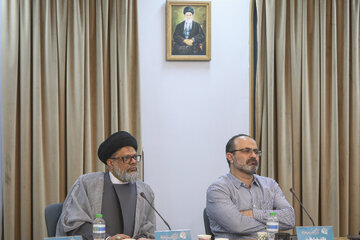
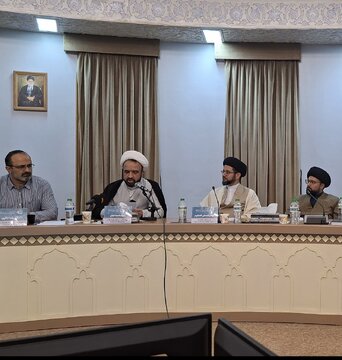
Ahlul Bayt (AS) International News Agency - ABNA: Shaykh Javad Esmaeili, a researcher and the director of the Europe and America Department of the Ahlul Bayt (AS) World Assembly, delivered the concluding address at the 9th International Pre-Meeting of the 6th Imam Reza (AS) Global Congress, themed “Human Rights and Dignity in the Civilizational Teachings of the Ahl al-Bayt (AS) with an Emphasis on the Teachings of Imam Reza (AS).” As the last speaker, he began by acknowledging that the audience might be tired and therefore expressed his intention to be brief while still sharing what he hoped would be the most beneficial points. He prayed that both he and the listeners would benefit from the teachings of the Ahlul Bayt (AS), especially the teachings of Imam Reza (AS), noting the special significance of speaking in the holy city of Mashhad.
He opened by congratulating the audience on the occasion of Dahe-ye Fajr and emphasized the importance of the current year, describing it as a crucial period. Echoing remarks made earlier by other speakers, he encouraged everyone to participate in the 22nd of Bahman rally and to motivate their students, friends, relatives, and families to attend in greater numbers than in previous years. He also expressed his gratitude to all those involved in organizing the pre-meeting session.
Turning to his paper, titled “Social Ethics in the Conduct of Imam Reza (AS),” Shaykh Esmaeili explained that he would focus briefly on Imam Reza’s social ethics, particularly during the period when the Imam held the position of crown prince. He noted that there is an important difference between the guidance of a scholar who holds no governmental position and that of one who is formally within the structure of power. Since Imam Reza (AS) held an official position at that time, his teachings and conduct provide a model for how governance itself should embody Islamic ethics within society.
As an introduction, he stated that the stability of social relations largely depends on adherence to ethical principles. He emphasized the integration of two essential dimensions of social life, ethics and society, something he said Imam Reza (AS) successfully achieved. His presentation, he explained, sought to examine the most important components involved in creating moral capability within society from Imam Reza’s perspective. He defined social ethics as the moralization of society in both method and purpose: in method, by preserving human dignity and respect and observing ethics at the highest levels of society so that people follow them; and in purpose, by enabling society itself to assume a moral character.
Shaykh Esmaeili stressed that society cannot survive without morality and that purely human relations cannot truly prosper without divine morality. Otherwise, he said, self-interest becomes the dominant discourse, a phenomenon observable in secular societies where personal benefit becomes the ultimate measure of everything. In the absence of morality, individual self-benefit becomes the final goal, but Imam Reza (AS), he explained, demonstrated how social ethics can prevent such a narrow worldview and make people aware of the harm caused by a life driven solely by personal gain. In a moral society, he added, honor, self-respect, and the dignity of the soul are absolute duties, and no moral society allows humiliation or sacrifices human honor for material benefit.
In this context, he cited a profound statement from Imam Sadiq (AS): God has given human beings the power to do all things, but He has not given them the option to submit to humiliation. Shaykh Esmaeili explained that this teaching defines the limits of self-interest, clarifying that if an action leads to humiliation, it is not permitted. He added that in social ethics, the methods used to achieve goals must also be legitimate and moral. According to the teachings attributed to Imam Reza (AS), the pillars of power in society must be built upon solid ethical foundations.
He then outlined several dimensions of Imam Reza’s life that relate to social ethics, including his commitment to truth, his rejection of the desire for power, his observance of divine limits in society, his emphasis on the traditions and methods of the Prophet Muhammad (PBUH) and Imam Ali (AS), his respect for human dignity, and his refusal to grant special privileges to the elite. These, Shaykh Esmaeili said, form the core pillars of Imam Reza’s social ethics. In the Imam’s life, morality and society were so closely intertwined that there was effectively no separation between them. While modern governance often presents ethics and authority as competing priorities, Imam Reza’s conduct demonstrated that governance and ethics can and must coexist.
Among the key aspects of Imam Reza’s social ethics, Shaykh Esmaeili identified righteousness as fundamental. From Imam Reza’s perspective, ethics are rooted in righteousness and divine commitment, reflected in both personal and social conduct. Citing a statement recorded in the book Ihqaq al-Haqq by Shushtari, he quoted Imam Reza (AS) as saying that if leadership of the Muslims were entrusted to him, he would act according to obedience to God and the Sunnah of His Prophet, would not shed blood unjustly, and would not take honor or wealth unjustly from others. Shaykh Esmaeili contrasted this with rulers who, upon gaining power, quickly turn to oppression, emphasizing that Imam Reza viewed authority solely as a means to uphold truth and righteousness.
Another essential element, he said, was Imam Reza’s denial of the desire for power. Imam Reza (AS) initially refused the offer of becoming crown prince while in Medina, believing that acceptance might lead people to think he sought power, whereas in reality power had been imposed upon him. This reflected the broader teaching of the Ahlul Bayt (AS) not to pursue worldly power but to let worldly matters follow divine truth. Shaykh Esmaeili explained that Imam Reza viewed God as the embodiment of absolute power, stating that God does what He wills, that nothing obstructs His wisdom, and that His decree cannot be reversed. Such a worldview, he said, prevents arrogance and preserves humility and reliance on God, teaching that governance is a heavy responsibility entrusted by God rather than an opportunity for personal gain or wealth.
Observance of divine limits was another defining feature of Imam Reza’s social ethics. Shaykh Esmaeili noted that respecting divine boundaries ensures a moral society and prevents individuals from using unethical means to achieve their goals. He contrasted Islamic ethics, which integrate divine morality with human rights, with secular systems that neglect this balance, emphasizing that ignoring either dimension prevents society from achieving true moral completeness.
He also highlighted Imam Reza’s strong emphasis on following the tradition and method of the Prophet Muhammad (PBUH) and Imam Ali (AS). Imam Reza consistently stated that he would act exactly as his forefathers had acted. As an example, Shaykh Esmaeili recalled the incident in which the Abbasid caliph Ma’mun asked Imam Reza to lead the Eid prayer. Imam Reza agreed only on the condition that he lead it in the manner of the Prophet. Fearing that such an act would diminish his own authority, Ma’mun ultimately prevented the Imam from leading the prayer. Shaykh Esmaeili also noted that Imam Reza (AS) would begin his letters with blessings upon the Prophet and his family, a practice mirrored today in Islamic media and public discourse.
Another crucial principle in Imam Reza’s conduct, he explained, was prioritizing the preservation of religion over personal interests. Despite deep disagreements with Ma’mun, Imam Reza cooperated to the extent necessary to prevent societal division and collapse, believing that social stability was essential for truth to be expressed. At the same time, this cooperation never prevented him from speaking the truth. Shaykh Esmaeili noted that Imam Reza openly told Ma’mun that he had usurped the rightful position of the Imamate, demonstrating moral courage and commitment to truth even in difficult circumstances.
Human dignity was another central theme. Imam Reza (AS), he said, believed in the inherent dignity of every human being regardless of knowledge, belief, wealth, or status. Historical accounts describe him as never offending anyone through words or behavior, even while holding the position of crown prince. This conduct stood in sharp contrast to the behavior of Abbasid rulers and served as a moral model for both society and government.
Finally, Shaykh Esmaeili highlighted Imam Reza’s avoidance of granting privileges to those close to him or allowing his position to be used for personal benefit. He described this as a crucial lesson for contemporary society and governance, emphasizing that holding a position of authority should never become a means for others to exploit power for private gain.
He concluded by thanking the audience for their attention, reaffirming that these ethical principles from the life of Imam Reza (AS) remain vital lessons for individuals, societies, and governments alike.

Your Comment