

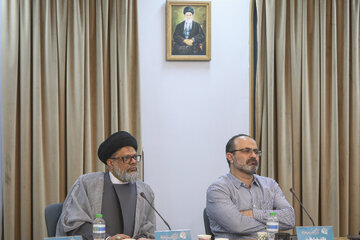
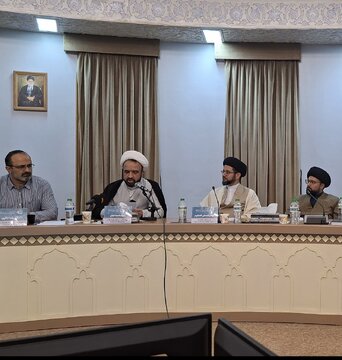
Ahlul Bayt (AS) International News Agency - ABNA: Syed Farman Ali from the United States was among the speakers at the 9th International Pre-Meeting of the 6th Imam Reza (AS) Global Congress, held under the theme “Human Rights and Dignity in the Civilizational Teachings of the Ahl al-Bayt (AS) with an Emphasis on the Teachings of Imam Reza (AS).” A researcher and international propagator on Islamic matters in the United States, he presented a paper titled “Minority Rights and Social Justice in the Razavi Logic of Governance,” in which he explored governance, justice, and minority protection from a theological, ethical, and policy-oriented perspective.
He explained that when minority rights are examined through the lens of security management and governance, and especially from a theological perspective, they offer a deeper diagnosis of why governance systems fail. According to him, Islamic political ethics does not view justice as merely procedural legality or formal compliance with laws accompanied by a superficial moral commitment to God’s commands. He stressed that when governance fails minorities, it is not only inefficient or flawed, but religiously illegitimate.
Syed Farman Ali emphasized that his paper raises a central question: what would governance look like if minority rights were treated as an act of obedience to God rather than as political concessions granted by a majority? He pointed out that across the globe, minority rights remain deeply contested despite constitutional guarantees and international human rights frameworks, with minority communities continuing to face systematic discrimination, socio-economic exclusion, and political marginalization.
He identified a fundamental weakness in many contemporary systems of governance, noting that they rely heavily on procedural legality, laws, institutions, and formal equality, while neglecting ethical legitimacy, which he referred to as Mashrooiyat-e-akhlaqi. This gap between law and justice, he argued, raises a serious question about whether such systems are capable of producing inclusive and genuinely just societies.
Turning to the Razavi logic of governance, Syed Farman Ali explained that it is derived from the teachings, conduct, and intellectual engagements of Imam Reza (AS). In Shia theology, he said, authority or Wilayah is inseparable from moral and ethical responsibility. Governance, in this framework, is an Amanah, a trust granted by God and held temporarily. Illegitimacy, he noted, does not emerge from the absence of majority rule or from majority domination, nor from coercive capacity or ijbaari enforcement. He emphasized that legitimacy does not arise from popular consent alone, but from continuous alignment with justice.
Within this framework, he stressed that minority rights are not privileges granted by the majority, but Haquq-e-wajib, obligatory rights. These rights include freedom of belief, the absence of forced conformity, equal legal protection, and security from both societal and state violence. He emphasized that protecting dignity even when beliefs differ must be reflected in policy, welfare, and law.
To illustrate this point, Syed Farman Ali compared recent unrest in Iran with developments in Western societies, particularly the United States. He explained that when protests began in Iran, they initially included peaceful demonstrations, which were even supported by the Supreme Leader and by Iran’s president, Mr. Pezeshkiyan. However, he said these peaceful protests were later hijacked by rioters, leading to violence, including the killing of innocent people and members of security agencies.
He stressed that despite this, the response of Iranian security forces demonstrated extreme restraint. According to him, there was no policy of “fire for fire.” Instead, security personnel absorbed violence, taking bullets to their chests while protecting civilians and even, in some cases, the rioters themselves during the early stages. He said this restraint is one of the reasons why Iran has witnessed thousands of martyrs among its security forces.
In contrast, he pointed to recent protests in the United States related to immigration issues in states such as Minnesota and Florida. He cited a statement by a police chief in Florida who warned protesters that if they threw stones at police, their families should be prepared to collect their bodies for burial. According to Syed Farman Ali, this stark contrast highlights the difference between Islamic civilization and Western approaches, particularly in terms of protection from societal and state violence.
He then referred to Surah al-Mumtahana, in which Allah commands justice and kindness toward non-Muslims who do not fight Muslims or expel them from their homes. He described this verse as a direct Quranic mandate for justice and compassion toward minorities. Failure to protect minorities, he said, is not merely a policy error but an ethical violation that undermines the legitimacy of governance itself.
Syed Farman Ali cited Imam Ali (AS) from Nahjul Balagha, Letter 53, where Imam Ali states that people are either brothers in faith or equals in humanity. From this principle, he drew policy implications, emphasizing that minority protection must be structural rather than symbolic. He said this requires independent legal safeguards, equal access to public goods, and strong institutional accountability mechanisms.
Addressing governance in pluralistic societies, he highlighted dialogue as one of the most distinctive features of the Razavi logic. He recalled how Imam Reza (AS) famously engaged scholars from Christianity, Judaism, Zoroastrianism, and various Islamic schools in public debates during the reign of Mamun. These encounters, he said, were dialogical, voluntary, rooted in reason and hujjah, and aimed at understanding rather than domination. He emphasized that this model establishes a key governance principle: the state must cultivate a public sphere where deep differences are managed through reasoned engagement rather than repression.
Syed Farman Ali then addressed social justice as a systemic obligation. In the Razavi framework, he explained, minority rights and social justice are inseparable. Justice extends beyond legal codes and constitutions to include economic equity, redistribution of wealth, and social welfare. He noted that in Razavi theology, poverty is not accidental but often a sign of injustice. Quoting a hadith referenced earlier in the panel, he highlighted the principle that the sustenance of the poor is a right within the wealth of the rich, reframing poverty as a systemic failure rather than a personal one.
According to him, governance must therefore be evaluated by its ability to design institutions that ensure access to healthcare, education, and resources for all, regardless of creed or ethnicity. He cited a hadith of the Prophet Muhammad (PBUH) emphasizing the sanctity of the rights of non-Muslims, in which the Prophet warns that anyone who wrongs a person under covenant, diminishes their rights, burdens them unjustly, or takes from them without consent will face the Prophet as an adversary on the Day of Resurrection.
Drawing further policy implications, Syed Farman Ali said that welfare systems must be understood as instruments of justice rather than charity. Economic exclusion of minorities, he argued, represents a failure of governance, and equity must guide taxation, education, and healthcare access.
He noted that while the Razavi logic of governance is rooted in Islamic ethical tradition, it resonates strongly with modern human rights and social justice discourse. He said it complements rather than contradicts contemporary legal frameworks by providing moral depth, reinforcing accountability, and centering human dignity. At the same time, he cautioned that it must be applied as a normative ethical framework rather than a rigid political blueprint to avoid politicization or exclusionary misuse.
In concluding his remarks, Syed Farman Ali stated that the Razavi logic of governance envisions a state defined by three essential qualities: a just arbiter, a moral trustee, and a guardian of human dignity. By grounding political authority in universal justice, inherent dignity, and active moral responsibility, he said, this framework directly challenges governance models that marginalize minorities.
He ended his speech by quoting Imam Ali (AS) from Nahjul Balagha, who said that God has made it obligatory upon just leaders to consider themselves equal to the weakest among the people, so that the poor are not overwhelmed by their poverty. He thanked the audience for their patience and expressed appreciation to the organizers of the pre-meeting before concluding his presentation.

Your Comment