

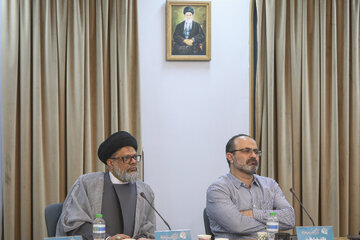
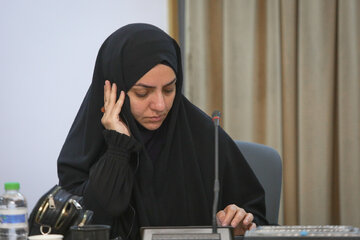
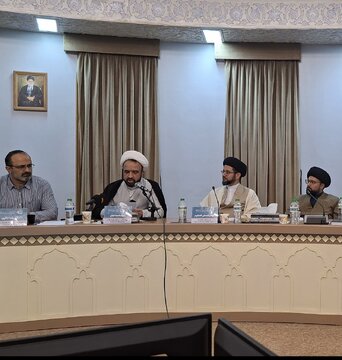
Ahlul Bayt (AS) International News Agency - ABNA: At the 9th International Pre-Meeting of the 6th Imam Reza (AS) Global Congress, held under the theme “Human Rights and Dignity in the Civilizational Teachings of the Ahl al-Bayt (AS) with an Emphasis on the Teachings of Imam Reza (AS),” Azerbaijani international media activist and Islamic propagator Yegana Naghi Yevh addressed the principles of social solidarity in the Razavi tradition, warning that the erosion of unity through media manipulation and political pressure remains one of the greatest challenges facing Muslim societies today.
Yegana Naghi Yevh began her speech by explaining that the Quran, Islamic laws, and most Islamic teachings are fundamentally social in nature. She said that if a human being truly wants to build themselves and reform their character, they cannot do so in isolation. A person must live within society, because society inevitably consists of people from different backgrounds, ethnicities, and beliefs, something that is clearly visible in Iran as well. According to her, personal growth is only possible when an individual places themselves within a social environment. She added that this social journey can begin from the smallest unit of society, which is the family.
She explained that when a person learns and practices good conduct, solidarity, and constructive behavior within the family, they become more successful within society at large. She noted that in society, as in her own country and in Iran, there are Muslims, Jews, and people of different faiths living together. For this reason, she emphasized, Islam places strong importance on social solidarity.
According to Yegana Naghi Yevh, one of the greatest problems facing Muslims today is the weakening of this very solidarity. She said that enemies actively use media and virtual space to scatter and divide societies. She added that when people define themselves primarily by ethnicity or region, such as saying “I am Turk,” “I am Lor,” or “I am from this place and that place,” it is a disrespect to human dignity. She pointed out that when the Prophet of Islam (PBUH) began his mission, one of the first issues he addressed was creating unity and solidarity among people.
Referring to recent events in Iran, she said that people witnessed how media attacks targeted social unity, how innocent blood was shed, and how innocent people were martyred. She said that during those days, it felt as if people were witnessing Karbala with their own eyes. She stressed that the enemy did not plan these events for only a few days, but had been plotting for years. She added that these efforts are not limited to Iran alone, noting that similar attempts to destroy solidarity are seen in Gaza, Syria, and other regions.
Despite this, she said that Iran demonstrated a remarkable level of unity. She explained that after recent events, people acted with awareness and stood up on Jan 12 in unique rally to defend the Quran, Islam, and their country. However, she expressed regret that such unity is not seen in many other parts of the world, especially regarding Palestine. She criticized the attitude of those who say that what happens in Palestine has nothing to do with them. She warned that such people are unaware that the enemy does not only plan against Iran, Palestine, or Lebanon, but has plans for every Muslim country, including Azerbaijan, which she said she would address further.
Yegana Naghi Yevh emphasized that in Islam there is no concept of “it does not concern me.” She said Islam operates with comprehensive planning in all areas of life. She recalled that the Prophet of Islam worked to eliminate divisions such as Arab and non-Arab. She then referred to the life of Imam Reza (AS), narrating an incident during the Imam’s journey to Khorasan. According to the narration, when it was time to eat, Imam Reza invited everyone to the same table, including servants and people from different ethnic backgrounds. When someone suggested that their table be spread separately, Imam Reza firmly told him to remain silent, explaining that Allah created everyone equally, that all humans share the same parents, and that it is deeds alone that determine whether a person is rewarded or punished by God.
She explained that this narration highlights two important points in the teachings of Imam Reza (AS). The first is inherent human dignity, which is innate and affirmed by Allah in the Quran when He says that He created humans in the best form. The second is acquired dignity, which develops when a person reaches maturity, fulfills their responsibilities, and lives freely, either elevating or diminishing their moral status through their actions. She said that if these principles were applied in daily life, many social problems would be resolved.
Yegana Naghi Yevh then spoke about factors that strengthen social solidarity, emphasizing tolerance as one of the most important. She said that while the situations in countries like the United States, the United Kingdom, Gaza, and Syria are widely known, the situation in Azerbaijan remains unclear to many, even to Azerbaijanis themselves. She pointed out that if one searches online for the most tolerant country, Azerbaijan is often mentioned, and even the Azerbaijani government promotes this image.
However, she questioned this narrative, asking how a country with a predominantly Shia population can be considered tolerant when Shias do not have access to their own religion. She asked why thousands of Shias are imprisoned, including women, simply for mourning rituals or for following the Ahl al-Bayt (AS). She said that in such a so-called tolerant country, Shias are forced to practice taqlid secretly and are unable to openly follow Shia scholars. She emphasized that because media is controlled by hostile forces, events in Iran and elsewhere are often presented in a completely distorted manner.
She said that the level of misinformation is so severe that had she not been present in Iran herself, she might have believed the false narratives. She stressed that international students and scholars have important responsibilities, the foremost being to convey accurate and truthful narratives. She said that what happens in Iran is often shown in the exact opposite way to audiences abroad, making it essential to correct these misrepresentations. She added that international students act as ambassadors of their countries and have a duty to present accurate accounts from all sides. She emphasized that if someone knows multiple languages, they must not neglect their responsibility to convey the truth in all of them.
Speaking specifically about Azerbaijan, she said that Shia propagation is officially banned, and those who engage in it face punishment. Students who travel abroad to study Islam face severe hardships, including being barred from re-entering the country or being imprisoned. She said that the Ahl al-Bayt (AS) are oppressed, in Azerbaijan. While mosques may appear active on the surface, she said these institutions are controlled by an oppressive state. She described severe restrictions, including being forbidden from wearing black clothing or displaying symbols such as 313, noting that such symbols are forcibly removed if worn.
She concluded by saying that although she had much more to say, time constraints limited her remarks. She emphasized that social solidarity requires fairness and justice. She called on people to stand together, address weaknesses, focus on strengthening unity, and support one another in order to build resilient and dignified societies rooted in Islamic values.
Your Comment