

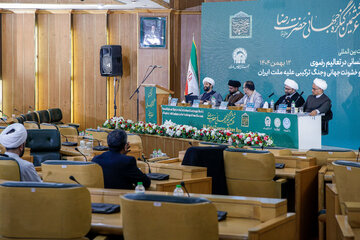
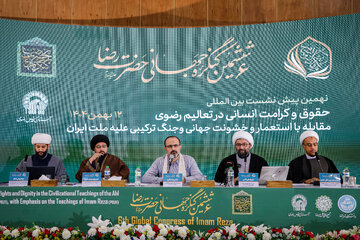
Ahlul Bayt (AS) International News Agency - ABNA: At the 9th International Pre-Meeting of the 6th Imam Reza (AS) Global Congress, titled “Human Rights and Dignity in the Civilizational Teachings of the Ahl al-Bayt (AS) with an Emphasis on the Teachings of Imam Reza (AS),” Syed Shahryar Mehdi Naqvi, a well-known international Islamic media propagator from the United States of America, presented a paper emphasizing that divine knowledge is the only true path to humanity’s ultimate salvation.
Speaking as one of the panelists at the international gathering, Syed Naqvi explained that his paper, titled “Divine Knowledge as a Key to Salvation in the Razavi Tradition,” primarily dealt with the concept that divine knowledge alone leads to the ultimate salvation of humanity. He stated that his work drew upon at least two traditions from Imam Reza (AS), one describing the world as entirely ignorance (jahl) except for the positions of knowledge, and the other declaring that knowledge is the root of all good, while ignorance is the root of all evil. He said that through his paper, he humbly sought to open up and explore this concept of knowledge.
Syed Naqvi elaborated that knowledge can be broadly divided into two primary levels. He explained that the lower level of knowledge deals with the physical sciences, such as biology, chemistry, and mathematics, and their practical benefits, noting that this form of knowledge is limited to the material realm, the dunya, or the world. Beyond this, he said, lie higher levels of knowledge, and it is these higher levels that enable humanity to attain ultimate salvation.
He further explained that this higher or divine knowledge, which helps humanity achieve salvation, is taught through the teachings of pure Mohammadan Islam. According to Syed Naqvi, these higher levels of knowledge guide the lower levels and place them within a divine framework, while also adding dimensions that are absent from material knowledge alone. He noted that although physical sciences are confined to the material ground, they are elevated and guided by higher knowledge, and it is this guidance that ultimately enables humanity to reach perfect and complete salvation.
Syed Naqvi went on to explain that the higher levels of knowledge have been categorized into four primary areas. He identified these as knowledge of the Creator, or knowledge of Allah; knowledge of the self, meaning the human being and the individual; knowledge of social interactions among human beings; and knowledge of the interaction between human beings and the environment. He attributed this categorization to the masters of ethics and Irfan, stating that it was derived from their teachings.
He stressed that humanity’s ultimate divine salvation cannot be achieved through lower levels of knowledge alone. Referring again to the physical sciences such as chemistry, biology, and mathematics, he said that while these fields represent important forms of knowledge, they are insufficient to bring about ultimate salvation.
Drawing attention to the contemporary world, Syed Naqvi pointed to the remarkable technological advancements seen today, particularly in Western civilization. He argued that Western civilization itself serves as evidence that mastery over physical sciences and technological progress does not lead to ultimate salvation. Despite unprecedented advancements in science and technology, he said, Western societies continue to experience oppression, social injustice, discrimination, racism, poverty, and homelessness. He questioned how such a civilization, despite its dominance in technology and lower forms of knowledge, has failed to guide humanity toward true salvation.
Syed Naqvi stated that, in light of this reality, only one option remains, and that is the path presented by Almighty Allah through pure Mohammadan Islam. He emphasized that it is the divine knowledge offered by Islam, within the four categories he outlined, that invites humanity toward ultimate salvation in both this world and the hereafter.
He also referred to a statement by Imam Syed Ali Khamenei regarding modern Jahiliya, or modern ignorance. Syed Naqvi explained that while Western civilization exhibits astonishing technological progress, it is nonetheless afflicted by modern Jahiliya. He said that, based on Imam Khamenei’s statement, this condition arises because Western societies have mastered the lower sciences but lack access to higher-level divine knowledge as presented by pure Mohammadan Islam.
Describing his paper as long and intricate, Syed Naqvi said his remarks at the panel were intended as a superficial teaser. He concluded this portion by highlighting what he called the on-the-ground manifestation of the idea that true salvation lies in combining mastery of lower levels of knowledge with guidance from higher levels of knowledge.
According to Syed Naqvi, the present-day manifestation of this combined approach can be seen in the Islamic Republic of Iran. He stated that Iran has achieved remarkable and miraculous technological advancement and mastery over lower-level sciences, while simultaneously striving to establish a moral and just society within the framework of the Islamic Revolution. He said these efforts represent significant steps toward humanity’s ultimate salvation.
Syed Naqvi argued that when a model like the Islamic Revolution succeeds in integrating lower and higher forms of knowledge—something he said Western civilization has failed to do—it inevitably attracts the hostility of arrogant global powers. He said this enmity from man-made, non-divine systems has been evident for the past 47 years since the Islamic Revolution and will continue to intensify with each passing year.
He then posed the question of what should be done in such circumstances and answered that the first priority must be defense. Syed Naqvi emphasized that defending the Islamic Revolution and the Islamic Republic means defending the model of pure Mohammadan Islam, defending the Ahlul Bayt (AS), and defending a system that paves the way for humanity’s ultimate salvation.
He stressed the importance of unity, saying that neither the Iranian nation nor non-Iranian peoples can achieve victory alone. Drawing a parallel with the Ansar and the Muhajir of early Islam, he called for collective defense of the Islamic Revolution and the Islamic Republic under the banner of the Islamic Revolution, which he described as the flag of the Ahlul Bayt (AS), pure Mohammadan Islam, and humanity’s ultimate salvation.
Syed Naqvi said that this unity must continue until the reappearance of the divinely appointed 12th Imam, the awaited savior of humanity. In his concluding remarks, he stated that while the era of ideological defense continues, the era of ideological offense has now begun and should have started long ago. He warned that failure to defend ideological boundaries and to advance ideological offense would result in the loss of the efforts of 124,000 prophets and the 11 noble Imams.
He concluded by saying that every moment wasted delays the reappearance of the Imam of the time and harms pure Mohammadan Islam. He ended with prayers for the protection of Ayatollah Syed Ali Khamenei, the Islamic Revolution, and the Islamic Republic, and for unity akin to that of the Muhajir and the Ansar to bring victory to pure Mohammadan Islam.


Your Comment